AOG & Operational Recovery
Miami Aircraft on Ground (AOG) — 24/7 Support from APAS
Aircraft on Ground AOG Miami? Immediate dispatch very close from MIA/KTMB, 24/7. Certified teams, logistics & documentation for first-pass RTS.

.png)
Aircraft on Ground AOG Miami? Immediate dispatch very close from MIA/KTMB, 24/7. Certified teams, logistics & documentation for first-pass RTS.
Aircraft on Ground (AOG) support in Miami means rapid coordination of technical response, parts, logistics, and compliance to return an aircraft to service as quickly and safely as possible.
Immediate dispatch near MIA / KTMB, 24/7. Certified teams, logistics, and documentation for compliant Return-to-Service (RTS).
From Latin America to Worldwide — Serving worldwide.
📍 6270 NW 37th Ave, Miami, FL 33147
When an aircraft goes AOG in Miami, operational disruption starts immediately. What matters most is not only speed, but the ability to coordinate technical action, parts, logistics, and documentation in parallel.
At APAS, the objective is clear: respond quickly, mobilize the right resources, and return the aircraft to service with full compliance. Operating from Miami with a 24/7 Operations Desk allows technicians, tooling, and parts to be routed without waiting for normal shop hours.
From the first call, engineering, logistics, and sourcing are aligned in the same workflow so that the next decision, action, and documentation step are clear from the start.
Aircraft on Ground (AOG) support is a coordinated response process designed to restore aircraft availability after an unscheduled event.
In practice, it combines:
The difference between delay containment and operational escalation is often the speed and clarity of this coordination.
For a deeper view of how maintenance workflows impact downtime, see Aircraft MRO Process Explained.
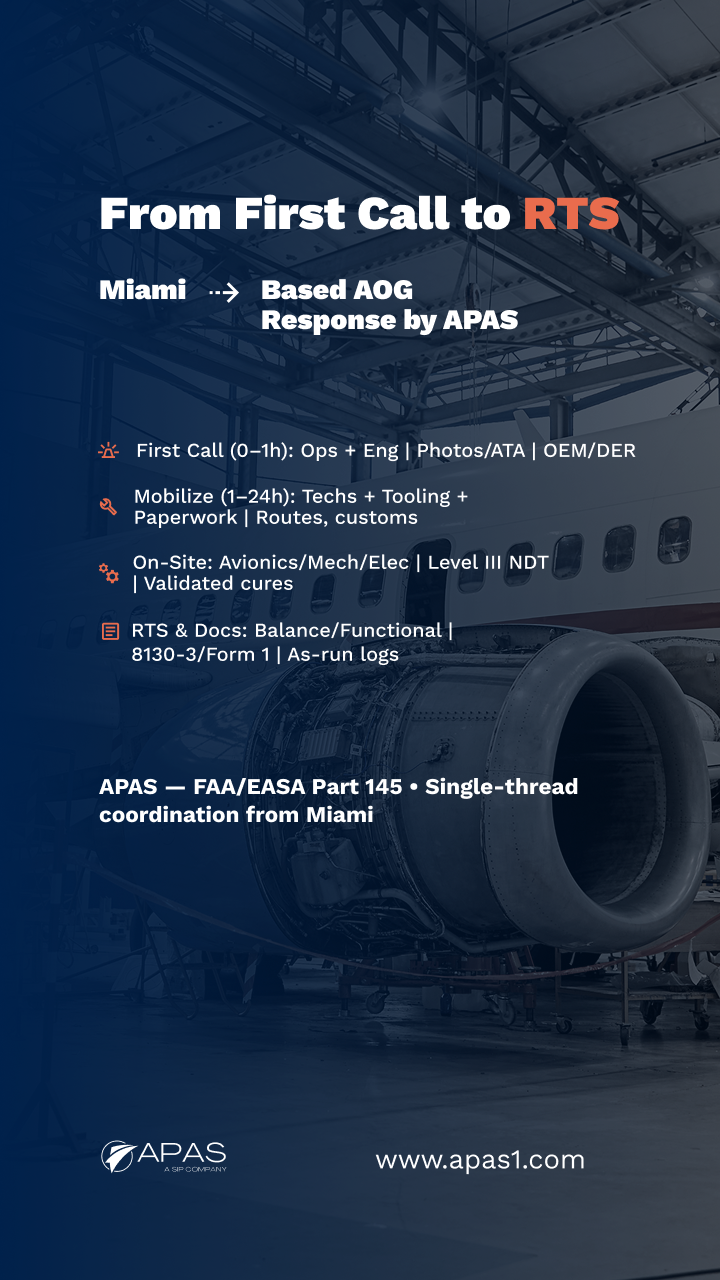
Minute 0–15:
The AOG Desk opens the case, confirms station constraints, and requests initial inputs such as ATA chapter, defect description, and damage photos.
Hour 1+:
Technicians, tooling, parts, and paperwork move in parallel, including customs-cleared routing when required.
Repair evidence, inspection records, and release documentation are prepared so the aircraft can achieve return to service under the applicable regulatory framework.
The objective is not just faster response, but a first-pass, audit-ready RTS with minimal operational friction.
AOG events often span multiple technical and operational domains. APAS supports the workstreams that most directly affect time-to-service:
This is how an AOG event is managed as a controlled workflow instead of a sequence of disconnected delays.
Speed without compliance creates downstream risk. A compliant AOG response requires the same discipline as any other controlled maintenance event.
APAS supports work under FAA / EASA Part 145 conditions with end-to-end traceability, including:
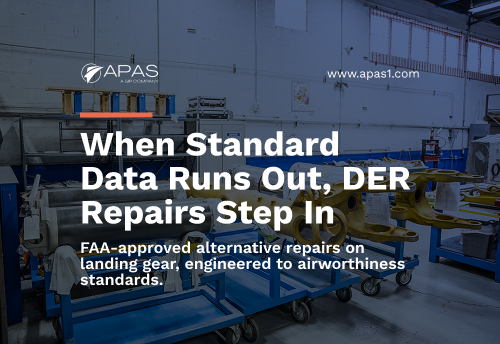
Where appropriate, DER-approved solutions may offer a compliant alternative path that protects schedule and cost without compromising regulatory standards.
The result is a cleaner audit trail for operators and QA teams, including release documentation, findings, photos, and supporting records.
AOG delays are often driven by part availability as much as technical labor. That is why APAS integrates:
This reduces fragmentation and gives operators a single coordination path from request through RTS.
For more on supply-related AOG risks, see Managing Aircraft Groundings.
From Miami, APAS supports AOG response across the U.S., Caribbean, and Latin America through coordinated logistics and technical deployment.
This includes:
Miami functions as a strategic AOG hub due to its connectivity, logistics infrastructure, and proximity to key operating regions.
This enables:
APAS has supported programs and projects with operators including Turkish Airlines, Volaris, Avianca, LATAM, EasyJet, Atlas Air, Vueling, Iberia, and Arajet, and has worked with brokers and shops such as Setna, Heico, Avair, and Kellstrom.
For operators, this typically translates into:
AOG support is not only about speed. It is about synchronized execution across engineering, logistics, parts, and compliance.
From Miami, APAS is positioned to support faster response across the Americas with a model designed to reduce downtime, maintain traceability, and support efficient return-to-service.
Coordination begins on the first call. Dispatch timing depends on station access, logistics, and customs, but operations run 24/7.
Yes. This includes on-site diagnostics, component support, exchanges, and repair coordination.
Yes. Work is aligned with FAA / EASA Part 145 requirements, including traceability and release documentation.
Where appropriate, yes. DER-approved pathways can provide compliant alternatives.
Yes. Logistics, routing, permits, and customs are coordinated alongside the technical plan.