What Is Predictive Maintenance in Aviation? (And How It Really Impacts Your MRO Procurement)
Turn early alerts into smarter stocking, fewer emergencies, and stronger supplier performance. A plain-English guide for aviation procurement leaders.
In the current aviation climate, characterized by a global MRO backlog and erratic supply chains, procurement has shifted from a back-office administrative function to a frontline competitive strategy. For the modern Director of Maintenance or VP of Supply Chain, "business as usual" is no longer enough to keep a fleet airworthy and profitable.
Predictive Maintenance (PdM) has arrived. Far from being a niche technical tool, PdM serves as a critical catalyst for procurement strategy. It provides the foresight necessary to transition from reactive purchasing to proactive asset management.
For a partner like APAS, an FAA/EASA Part 145 Repair Station, predictive maintenance is the key to unlocking true Asset Readiness.
1. Beyond the Sensor: Predictive Maintenance as a Procurement Signal
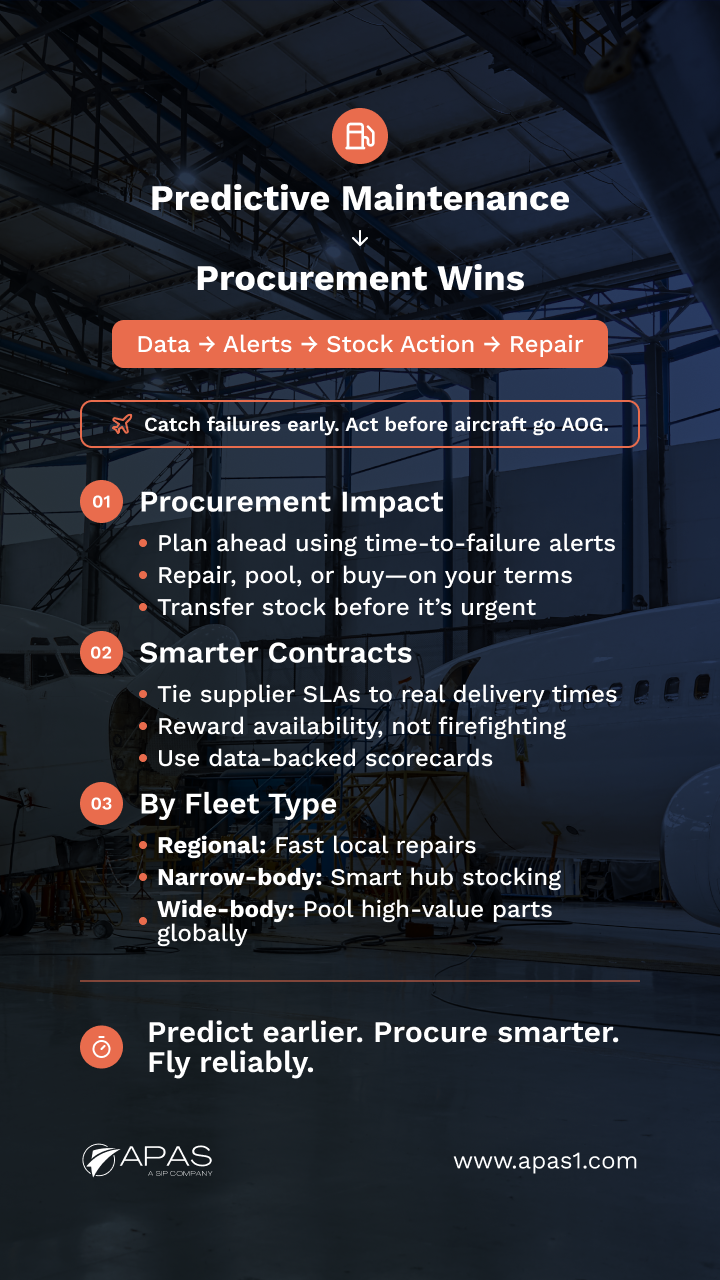
At its core, predictive maintenance means spotting equipment wear and tear before it triggers a failure. However, for a business leader, the value lies in what happens after the data is collected. PdM provides an estimated time to failure (ETF). If that window is shorter than your supplier’s lead time, the system triggers a proactive sourcing request.
Instead of reactive "firefighting," procurement teams use PdM data to:
Choose the Repair Path Earlier: Early warnings provide the luxury of time to choose between a repair, a pool exchange, or buying new at the best total cost—not the highest "emergency" price.
Pre-position Critical Stock: You can move rotables—like flight controls or actuators—to hubs (such as our Miami-based facility) before the aircraft even lands.
Reduce Obsolete Inventory: By using dynamic min/max levels based on real-time wear data, you avoid "just-in-case" overstocking that drains working capital.
2. Solving the "Global Backlog" with Lead-Time Intelligence
One of the primary pain points for aviation is the uncertain and prolonged delivery times currently plaguing the industry. When every MRO shop in the world is at capacity, a 60-day backlog can ground your aircraft indefinitely.
Predictive maintenance solves this by "buying time." If your sensors detect an abnormal pressure change in a hydraulic pump weeks before it reaches the limit, you can book a slot at a specialized shop like APAS before the part is ever removed. This "Slot Reservation" strategy turns the global backlog into a manageable schedule, ensuring your turn-around-time (TAT) is measured in days, not months.
3. The Three Pillars of Strategic Cost-Saving: DER, USM, and Repair Management
A major frustration for leaders is the high cost of repairs without clear technical justification. Predictive maintenance provides the data-backed "why" behind every maintenance dollar spent.
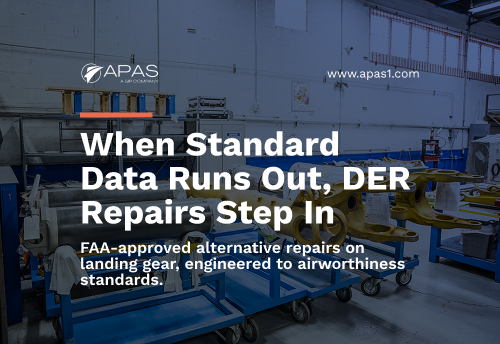
The DER Advantage: Strategic DER (Design Approval Organization) repairs often require more lead time for engineering than a simple OEM swap. PdM gives you that time. By choosing a DER-approved repair through APAS, you can save 30-50% compared to buying new.
USM Integration: Used Serviceable Material (USM) is most effective when it is sourced proactively. PdM allows you to identify which components will soon need replacement, giving your sourcing team time to find high-quality USM instead of being forced into a high-priced OEM purchase during an AOG.
Consolidated Support: By acting as a single-source partner for repair management, logistics (minutes from MIA), and engineering, APAS eliminates the need for multiple vendors, reducing the risk of "fragmented" communication.
4. Compliance and the "Transparency Dividend"
For lessors and owners, a part is only as valuable as its paperwork. Predictive maintenance enhances Governance and Traceability by closing the loop between the initial sensor alert and the final return-to-service tag.
A "Compliance-Ready" PdM program ensures:
End-to-End Traceability: Every alert, work order, and material movement is timestamped and documented.
Back-to-Birth (BtB) Accuracy: Continuous monitoring provides a flawless record of an asset's health, which is vital for lease returns and regulatory audits.
Audit Readiness: Digital logs replace the "black box" of traditional MRO, providing clear evidence for warranty claims and insurance audits.
5. A Phased Playbook for 2026
Aviation leaders often fear the complexity of adopting predictive tech. The most successful operators follow a phased approach over 90 days:
Discover: Rank your failure modes by cost and frequency. For many APAS clients, this starts with Accessories (Class I, II, III) and Flight Controls.
Pilot: Wire alerts into your existing inventory systems. Start with auto-reservations—where the system "flags" a part in the warehouse the moment a sensor detects degradation.
Industrialize: Add predictive-aware SLAs into your contracts. Demand that your MRO partner (like APAS) maintains specific availability for items flagged by your predictive models.
Scale: Expand to wide-body long-haul fleets where the cost of a cancellation is highest, using digital twins to test "what-if" scenarios.
Conclusion
Predictive maintenance doesn’t just lift reliability—it reshapes the entire procurement ecosystem. By shifting from reactive to proactive, you choose your repair paths on your terms, place parts where they are needed, and write contracts that reward performance rather than just parts.
At APAS, we bridge the gap between predictive data and physical reality. Our Miami-based hub, 30+ years of technical expertise, and DER-engineering authority make us the ideal partner for leaders who want to stop "reacting" to maintenance and start "managing" it.
Ready to turn your data into a competitive procurement advantage?Contact the APAS team today to schedule a Strategic Repair Management audit.
FAQ: Strategic Procurement Answers
1. What data is required to launch a PdM program? Start with flight data recordings and onboard fault messages. We recommend focusing on Accessories and Flight Controls, where degradation patterns offer the highest impact on TAT.
2. How do we choose which components to monitor first? Use a "Criticality Matrix." Target items with high failure rates and long OEM lead times to deliver the fastest ROI for your procurement budget.
3. How does Machine Learning (ML) improve predictive maintenance? ML identifies subtle patterns—like pressure drifts or temperature spikes—that manual monitoring misses, allowing procurement to secure parts weeks before a failure occurs.
4. When should we choose DER repairs over OEM replacements? When your Estimated Time to Failure (ETF) exceeds the shop TAT. A DER repair through APAS provides OEM-equivalent airworthiness at a 30-50% lower cost.
5. How does AI-powered maintenance impact aviation operations? AI automates alert triage and demand forecasting. It turns "emergency" repairs into scheduled events, ensuring fleet availability and optimizing technician labor.
6. Can predictive maintenance eliminate urgent shipping costs? It shifts spend from reactive couriers to proactive transfers. You can pre-position stock at our Miami hub before an AOG event ever triggers.
Rethink Repairs. Reclaim Your Budget.
Explore how DER Repairs from APAS can reduce costs, speed up turnaround, and extend component life—without compromising safety or compliance.

.png)