Aviation MRO, Explained From the Removable Component Up
MRO in aviation means maintenance, repair and overhaul. Here is what each level does, and what changes when the unit of work is the component, not the aircraft.
Aviation MRO, Explained From the Removable Component Up
MRO in aviation is the discipline of keeping an aircraft airworthy across its service life, and it covers three things that are usually named together and practiced separately: maintenance, the scheduled and unscheduled work that keeps the aircraft in condition; repair, the correction of a specific defect; and overhaul, a full strip, inspection and test against approved data. What almost every explanation of the term leaves out is that this work happens at three different scales, and the scale changes everything —who does it, where it happens, how long it takes, and what paperwork comes back.
This guide covers the term as an operator actually meets it, and then goes where the others stop: down to the removable component, the part with its own serial number and its own history, which is where a large share of an aircraft's downtime is actually decided.
What is MRO in aviation?
MRO stands for maintenance, repair and overhaul. In commercial aviation it describes the whole body of work required to return an aircraft, or any part of it, to an airworthy condition and to keep it there —performed by approved organizations, against approved technical data, and recorded in a way that can be audited for the life of the asset.
The three words are not synonyms and they are not asequence. They describe different depths of intervention, each with its owntrigger, its own cost and its own entry in the records.
Line, base and component: the three levels of aircraft MRO
Most aviation MRO explanations stop at the first two. The third is where component availability is won or lost.
Line maintenance happens at the gate and on the ramp, between flights. Daily checks, defect rectification, servicing — work measured in hours because the aircraft is expected to fly again the same day.
Base maintenance takes the aircraft out of service and into a hangar for scheduled checks of increasing depth. Work measured in days and weeks, planned far in advance because the slot itself is a scarce resource.
Component maintenance is different in kind, not just in scale. The unit of work is not the aircraft —it is the part that came off it. A line replaceable unit is removed, sent to a shop, worked on a bench, tested and released, and it travels with its own documentation. The aircraft does not wait in a hangar for that to finish. It waits for a serviceable unit to take the removed one's place, and that is a different problem with a different solution.
That distinction is the one this guide exists to make, because the three levels get taught as a hierarchy of size when they are really three different questions.
What changes when the unit of work is the component
Once the part is off the aircraft, four things stop being aircraft problems and become component problems.
Identity. The unit has a part number, a serial number and a history that follows it for life. Two physically identical units are not interchangeable on paper if their histories differ.
Location. The work happens in a shop that holds the capability for that part number, which may be nowhere near the aircraft. The movement of the unit from induction to release becomes part of the schedule, not an afterthought to it.
Authority. Whoever works on it must hold the approval for that class of work, and must use data an authority has accepted. Where the manufacturer's data does not cover the repair the operator needs, there is a separate route through approved repair data developed by a designated engineering representative.
Clock mismatch. The shop works in weeks. The operation works in hours. The whole availability question — stock, exchange, pooling — exists to reconcile those two clocks, and it is covered in depth in the piece on why a component repair takes weeks.
Level
Where it happens
The work
Measured in
What the aircraft waits for
Line maintenance
At the gate and on the ramp, between flights
Daily checks, defect rectification, servicing
Hours
Nothing more: it is expected to fly again the same day
Base maintenance
In a hangar, with the aircraft out of service
Scheduled checks of increasing depth
Days and weeks
The check itself, in a slot planned far in advance
Component maintenance
In a shop that holds the capability for that part number
The removed unit is worked on a bench, tested and released with its own documentation
Weeks
A serviceable unit to take the removed one's place
How a component moves through an MRO shop
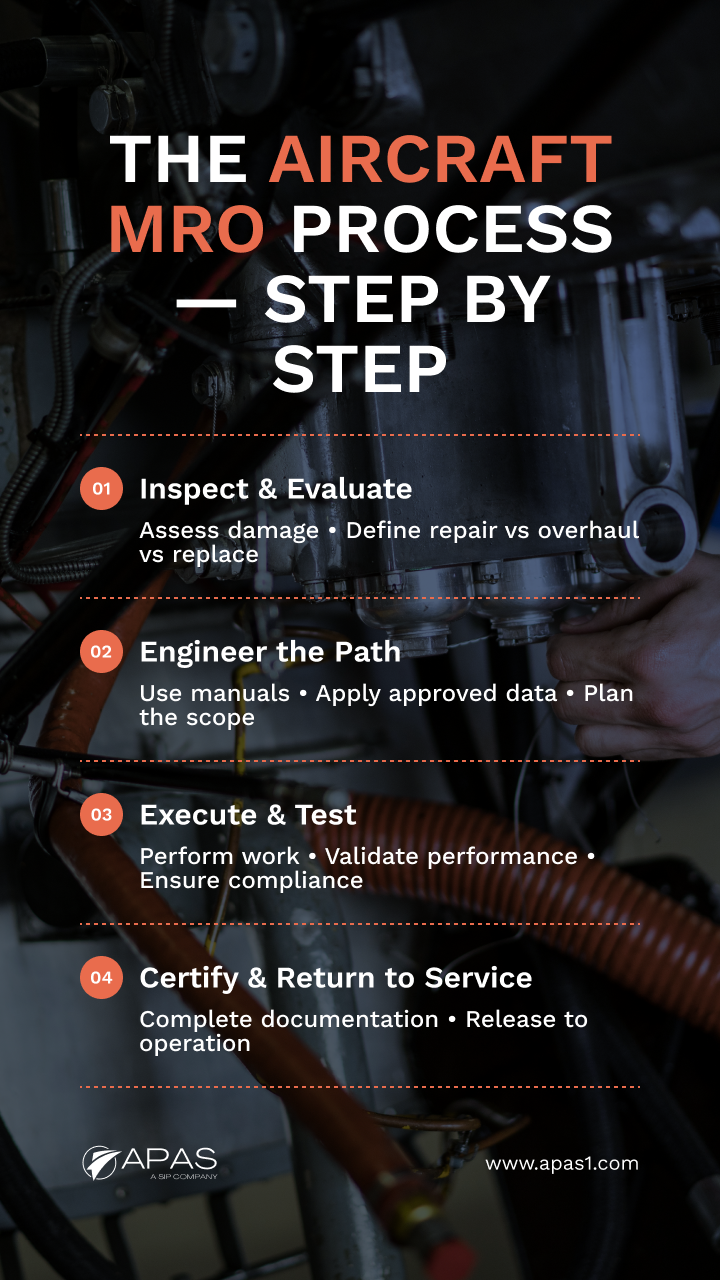
Four stages, in order, each with a decision attached.
Induction and evaluation. The unit arrives, is identified against its paperwork and inspected. The output is not a repair — it is a disposition: what is wrong, what the approved data allows, and what the realistic routes are.
Engineering assessment. Findings are read against the Component Maintenance Manual and the applicable approvals. This is where the scope is set, and where the difference between a targeted repair and a full overhaul is actually decided.
Execution and test. The work is performed and the unit is tested. What the test has to prove depends on the scope claimed, which is a regulated question rather than a commercial one.
Return to service. The unit is released with its documentation and goes back into the operator's inventory or onto an aircraft.
What an operator sends with the unit shapes how fast those four stages run. The part number and serial number, the removal reason in the operator's own words, the aircraft and position it came from, and any previous repair history all change the disposition. A unit that arrives with a vague removal reason and no history spends its first days in the shop being investigated rather than repaired, and that time is invisible on any quoted turn around because it happens before the clock most shops quote even starts.
The same is true in reverse at the end. A release that arrives without the documentation the operator's own records require is not finished work — it is work that has to be chased, sometimes weeks later, by someone who was not involved in the repair.
Repair, overhaul and the words that go in the record
A short version of a longer distinction, because it decidescost and lead time more often than any other single choice.
A repair addresses a documented finding. An overhaul is a complete disassembly, cleaning, inspection, repair as necessary, reassembly and test against approved technical data — and under the FAA rule on records of overhaul and rebuilding, a component may only be described as overhauled in a maintenance entry once that whole sequence has been completed. It is a records term with a test requirement attached, not a grade of quality.
Choosing between them is a scoping decision made against the condition of the unit, not a decision about how much quality to buy. The full comparison, including the third term almost nobody uses correctly, lives in overhaul versus repair.
What comes back with the unit
Every scope ends in paperwork, and in component MRO the paperwork is a large part of the asset's value. A maintenance record entry describes the work performed and when it was completed. A component released by an approved organization is normally accompanied as well by an authorized release certificate — FAA Form 8130-3 or EASA Form 1, depending on the approvals involved.
That documentation is what the next operator, the next lessor and the next appraiser will read. It is also what makes a repair defensible years later, when nobody involved is still at the company.
Where this applies in practice
Two families show the pattern clearly, and both are worth reading if the removable component is where your downtime lives.
Landing gear is the case where intervals are long, the money is significant and the record is scrutinized closely — the reasoning behind a landing gear overhaul is the component decision at its largest scale.
The ram air turbine is the opposite case: a unit that almost never operates and must work the one time it is called, which makes functional testing under real airflow the part of the job that matters most.
Frequently asked questions
What does MRO stand for in aviation? Maintenance, repair and overhaul. It describes the work required to return an aircraft or any of its parts to an airworthy condition and keep it there, performed by approved organizations against approved technical data.
What is the difference between line, base and component MRO? Line maintenance happens between flights, at the gate. Base maintenance takes the aircraft into a hangar for scheduled checks. Component maintenance works on a part that has been removed from the aircraft, on a bench, with its own documentation — and the aircraft does not wait in a hangar while it happens.
What is a line replaceable unit? A component designed to be removed and replaced on the aircraft without extensive disassembly, so the aircraft can return to service while the removed unit is worked on elsewhere.
Is component MRO the same as an aircraft check? No. An aircraft check is scheduled work on the aircraft as a whole. Component MRO is work on an individual removable part, triggered by a finding, an interval on that part, or its removal during a check.
What documentation comes back with a repaired component? A maintenance record entry describing the work performed and its completion date. A component released by an approved organization is normally accompanied as well by an authorized release certificate, such as FAA Form 8130-3 or EASA Form 1.
Who is allowed to perform aviation MRO work? An organization holding the appropriate approval for that class of work, using technical data an authority has accepted. The approval is specific: holding it for one class of component does not extend it to another.
Where to take this next
Aviation MRO is one term covering three levels of work, and the level decides almost everything an operator cares about: who performs it, how long it takes, what it costs and what comes back on paper. Line and base maintenance are about the aircraft. Component maintenance is about the part, and it follows different rules because the part has an identity of its own.
If the components are where your downtime accumulates, the next question is not a general one. It is whether a given part number can be supported, on what data, and in what time — and that is a conversation about our component services, not about the acronym.
Rethink Repairs. Reclaim Your Budget.
Explore how DER Repairs from APAS can reduce costs, speed up turnaround, and extend component life—without compromising safety or compliance.

.png)