.png)
Repair Strategy & Technical Solutions
How to Reduce Aircraft Turnaround Time (TAT) in MRO Operations
Learn how to reduce aircraft turnaround time (TAT) in MRO operations through better governance, engineering decisions, and logistics control.

.png)
Learn how to reduce aircraft turnaround time (TAT) in MRO operations through better governance, engineering decisions, and logistics control.
Aircraft turnaround time (TAT) is one of the most critical performance metrics in MRO operations. Delays in component repair cycles extend aircraft downtime, increase AOG exposure, and disrupt fleet planning.
Reducing TAT is not only about faster repairs — it is about governing the entire repair cycle, from induction and engineering decisions to logistics and delivery.
This article explains how aviation leaders can improve TAT through operational governance, using a structured, component-level approach.
Building on:
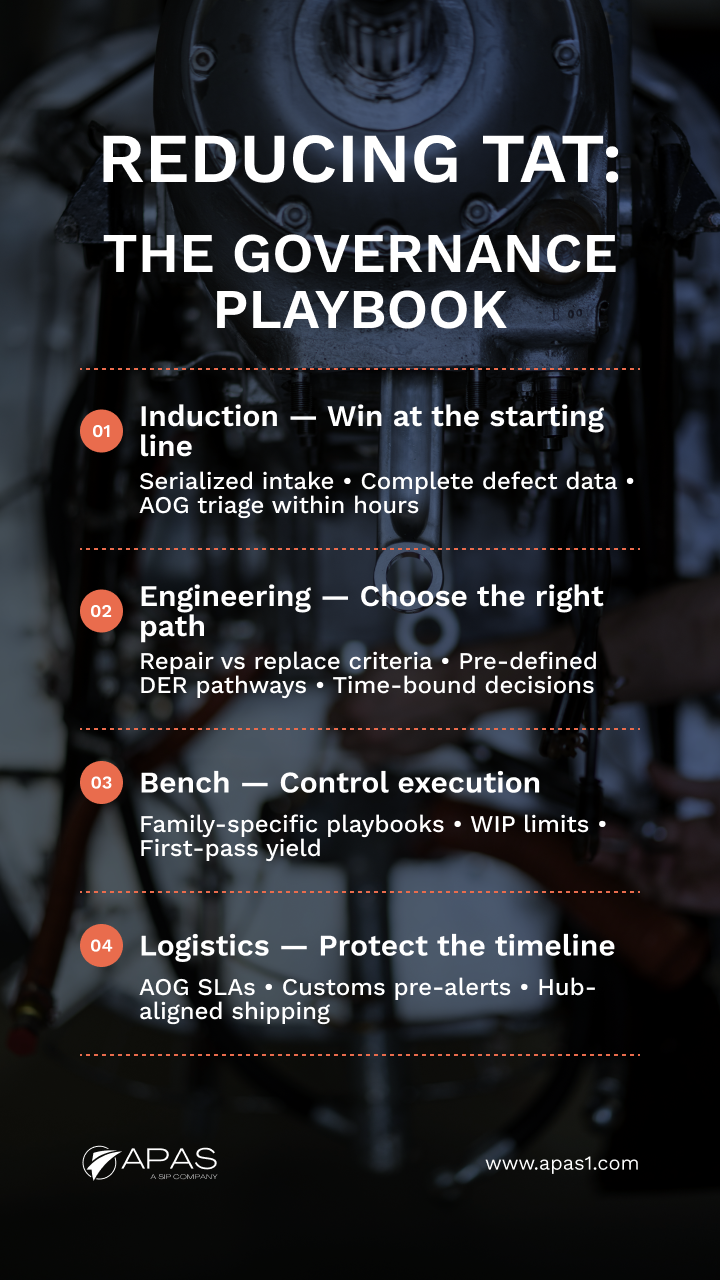
It provides a practical governance playbook for reducing TAT across critical component cycles—from induction and engineering decisions to logistics and delivery.
The objective is not faster repairs at any cost, but predictable, compliant, and repeatable TAT performance.
Aircraft turnaround time (TAT) refers to the total elapsed time required to repair, overhaul, and return a component or aircraft to service.
In component MRO environments, TAT typically includes:
Improving TAT requires visibility and control across all of these stages—not just the repair bench.
TAT performance is driven by four operational layers:
Bloated cycles rarely originate on the bench alone; they typically accumulate in the handoffs between stages—unclear induction criteria, fragmented data, serial approvals, and unmanaged logistics.
Industry data indicates that 10–30% of components removed for repair may result in No Fault Found (NFF), depending on system type and troubleshooting quality.
Effective induction control includes:
The “Hold Ticket” Rule:
If a unit arrives without sufficient defect data, it should be formally placed on hold rather than entering the active repair queue. Poor induction data is a leading cause of extended TAT.
For AOG units, triage should occur within hours of receipt, enabling faster engineering and material decisions.
Bench time should be governed through standardized, component-specific workflows.
Flight Controls:
Avionics:
Hydraulics:
Engineering approvals are one of the most common hidden bottlenecks in TAT.
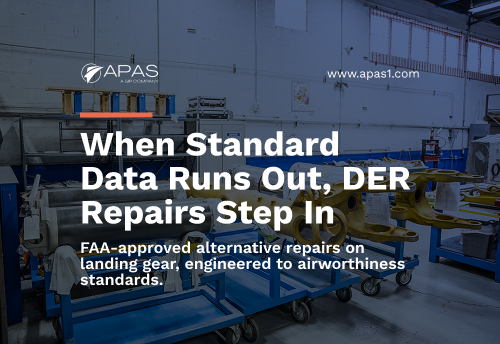
When repairs fall outside OEM manuals, Designated Engineering Representative (DER) involvement becomes necessary.
Key principle:
DER repair pathways should be pre-identified and approved within the operator’s engineering framework for recurring defects—not introduced as last-minute escalations.
Effective organizations:
DER repairs, when properly approved and documented in accordance with regulatory requirements and operator procedures, maintain full airworthiness.
Logistics is often underestimated, but can represent a significant portion of total turnaround time.
Critical improvements include:
Operationally, proximity to major hubs (such as Miami International Airport) enables faster response times for urgent component movements.
Final release to service (e.g., FAA Form 8130-3 or EASA Form 1) is part of the governed TAT cycle and should not become a bottleneck. Efficient documentation and certification processes are essential to maintaining flow.
Improving aircraft turnaround time is not about working faster—it is about working with greater control, visibility, and discipline.
Organizations that:
consistently reduce aircraft downtime and improve the predictability of turnaround performance.
In modern MRO environments, TAT is not just an operational metric—it is a reflection of engineering maturity and organizational control.
What is TAT in aviation?
Turnaround time (TAT) is the total time required to repair, overhaul, and return a component or aircraft to service.
What causes high TAT in MRO?
Common causes include poor induction data, high NFF rates, delayed engineering approvals, inefficient workflows, and logistics delays.
What is a good TAT benchmark?
This depends on the component type, but high-performing organizations focus on predictability, consistency, and first-pass success rates, not just speed.
Are DER repairs compliant?
Yes. When properly approved and documented in accordance with regulatory requirements and operator procedures, DER repairs maintain airworthiness.
MRO Series: From Process to Performance
APAS’s operating model — combining FAA/EASA Part 145 standards, DER pathways, AOG support, and Miami-based logistics — demonstrates how structured governance translates into shorter, more reliable repair cycles.