AOG & Operational Recovery
Aircraft Landing Gear Overhaul & Repair: What Operators Should Know
A clear operator guide to aircraft landing gear overhaul and repair: the process, inspection, NDT, DER repairs, Part 145 approvals and return to service.

.png)
A clear operator guide to aircraft landing gear overhaul and repair: the process, inspection, NDT, DER repairs, Part 145 approvals and return to service.
An aircraft landing gear overhaul is a full teardown, not an inspection. The assembly comes off the aircraft, is stripped to its individual parts, inspected against the manual, repaired or replaced where the findings require it, then reassembled, tested and released to service with complete traceability.
It earns that treatment. Landing gear absorbs the full weight and shock of every landing, folds itself away, and does it again on the next cycle.
Here is what the work involves, how it is controlled, and what return to service actually depends on.
Landing gear is a structural, safety-critical assembly. It carries the aircraft during taxi, takeoff and landing, manages the energy of touchdown through its shock struts, and steers and brakes the aircraft on the ground.
Those loads are relentless and cumulative. That is why the gear is one of the components most closely governed by the maintenance program.
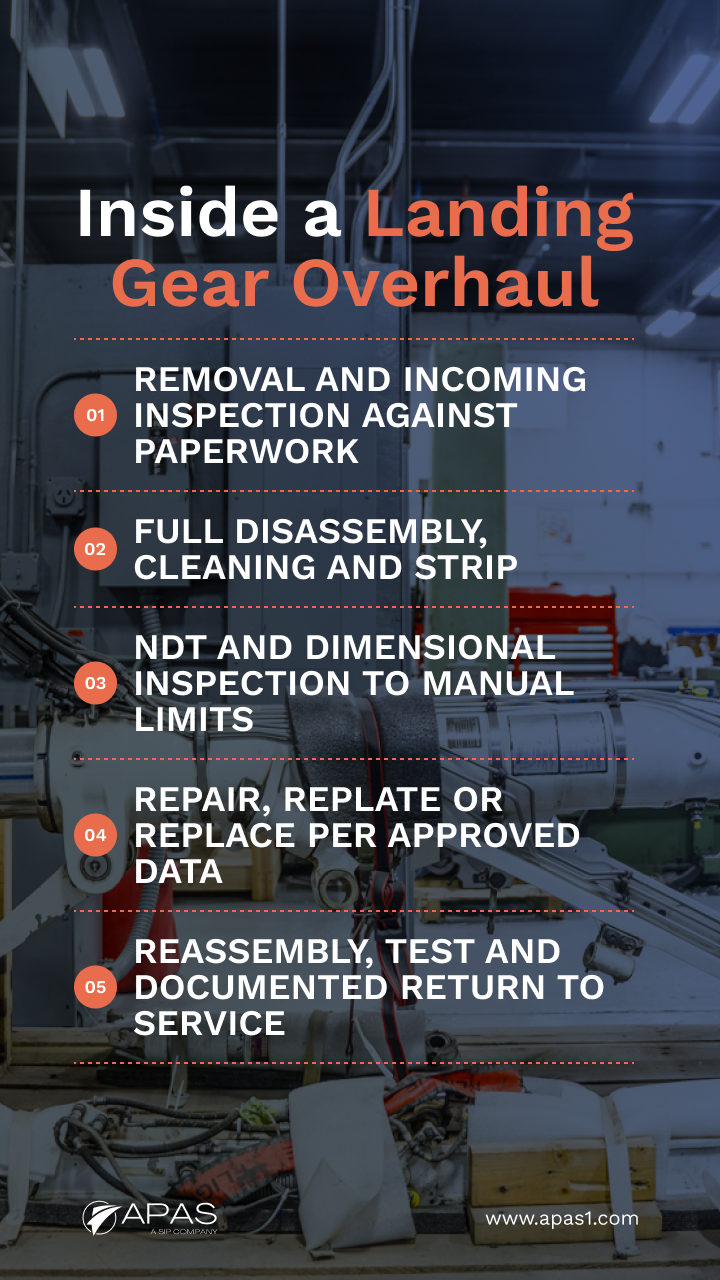
An overhaul is not a simple inspection. It is a full disassembly, cleaning, detailed inspection, repair or replacement of life-limited and worn parts, reprotection, reassembly and test — all performed to approved data.
The goal is to restore the assembly to a known, documented condition and return it to service with full traceability.
The exact steps follow the OEM component maintenance manual for each part number. But a landing gear MRO overhaul generally moves through a consistent sequence.
Each stage is documented, so the finished assembly carries a complete record of what was found and what was done
Landing gear inspection is where an overhaul earns its value.
The visible condition of a gear leg rarely tells the full story. Fatigue cracking and corrosion often begin in bores, radii and high-stress transitions that are only reachable once the assembly is stripped.
That is why an overhaul requires disassembly rather than an on-wing look.
Non-destructive testing examines those critical areas without damaging the part. Findings are measured against the manufacturer's limits, and any condition outside them drives a repair or replacement decision.
APAS holds an NDT rating on its FAA repair station certificate, which supports this inspection work in house as part of the overhaul flow.
Not every worn or damaged part means a new part.
Many conditions on landing gear structure can be restored through approved repair processes: grinding and replating to standard, bushing replacement, or machining to an approved repair dimension.
The controlling question is always whether approved data exists for the condition found.
When a condition falls outside standard manual coverage, an approved alternative may still be available through a Designated Engineering Representative (DER) repair.
APAS offers DER repair as one of its four service lines. It can preserve a serviceable assembly where standard data alone would call for replacement. A dedicated article in this series covers it in more depth.
A landing gear overhaul is only as good as the approvals behind it.
APAS operates as an FAA and EASA Part 145 repair station with more than 30 years in component MRO. Its FAA Repair Station certificate 79AR239B carries a Landing Gear rating, along with Accessory, Airframe, Limited Powerplant, Instruments, Radio and NDT ratings that support the surrounding work.
Return to service means the overhauled assembly is released with the correct approval and documentation, traceable to the part number, the serial number and the approved data used.
For the operator, that paperwork is what makes the gear installable and auditable. It should never be treated as an afterthought.
APAS works across landing gear overhaul and repair alongside its wider component capability: engines, avionics, flight controls and servo-controls, pneumatic and fuel systems, and Ram Air Turbines.
That breadth means the landing gear is handled in a shop that understands how components interact on the aircraft.
To start an evaluation, send the part number, serial number, aircraft application and the requested service.
AOG situations are supported 24/7, and exchange inventory may be available subject to part-number eligibility — which can protect the schedule while an overhaul is in progress.
An aircraft landing gear overhaul includes removal, full disassembly, cleaning, detailed inspection and NDT, repair or replacement of worn and life-limited parts, reprotection, reassembly and testing, all performed to approved data. The assembly is then released to service with documentation traceable to its part number and serial number.
Landing gear repair addresses a specific defect or condition. A full overhaul restores the entire assembly to a documented baseline through complete disassembly and inspection. Overhaul is typically driven by the maintenance program, whereas a repair may be triggered by a discrete finding or event.
The landing gear overhaul process requires full disassembly because critical fatigue and corrosion often start in bores, radii and internal surfaces that cannot be inspected on the aircraft. Stripping the assembly allows dimensional inspection and NDT of these hidden high-stress areas against manual limits.
Landing gear MRO should be performed by an appropriately rated repair station so the work and its return to service are properly approved. APAS is an FAA and EASA Part 145 repair station and holds a Landing Gear rating on FAA certificate 79AR239B.
Landing gear return to service means the overhauled assembly is released with the correct approval and complete documentation, traceable to the part number, serial number and the approved data used. That record is what allows the operator to install the gear and satisfy audit requirements.