Rotables: Exchange or Repair? How Operators Should Decide
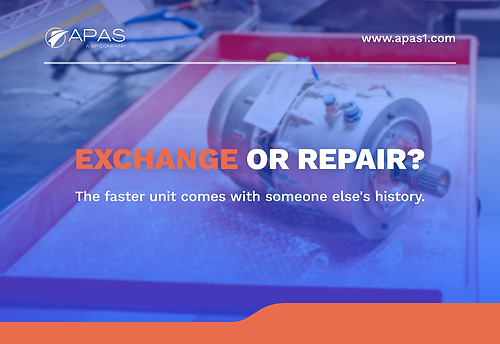
Rotables can be exchanged or repaired and returned. Four conditions decide which: eligibility, core condition, the records you trade and who carries the spare.
Exchange or Repair? Deciding What Happens to a Rotable
Rotables are the components an operator expects to repair and reinstall many times over the life of a fleet, tracked by serial number and by the hours, cycles and work recorded against them. Every time one comes off the aircraft, it forces a decision: wait for that same unit to come back from the shop, or install a serviceable unit from someone else's inventory and send yours in as the core. That is the exchange-or-repair decision, and it is less about speed than it looks.
An exchange does buy time. It also trades away something most buyers notice later: the history of the unit you owned, swapped for one you did not choose. Four conditions, all checkable before the removal, decide whether that trade is worth it. When all four hold, exchange is the right answer. When one fails, repairing your own unit usually is.
Rotable vs. repairable vs. expendable: what the terms mean
A rotable is a serialized component that can be restored to a fully serviceable condition repeatedly, so it keeps circulating between aircraft, shop and stores. A repairable can also be restored, but is not expected to cycle indefinitely. An expendable is used once and discarded. Exact definitions vary between operators, so check how your own maintenance program classifies each part number.
Only rotables make sense in an exchange, because only they can keep circulating. Three arrangements build on that:
· Exchange. You receive a serviceable unit now and hand over your removed unit, the core, which the provider repairs and returns to its own stock.
· Rotable pool. Several operators share access to a stock of serviceable units held by a pool provider, so no single operator carries spares for every part number.
· Consignment. Units owned by a supplier sit in your stores until you install one, and you pay when you use it.
Four ways to get a serviceable unit back on the aircraft
The options differ less in what they cost on paper than in what the aircraft waits for, and whose unit ends up installed.
Option
The aircraft waits for
Whose inventory carries the risk
The unit you end up with
Fits best when
Repair and return
The full door-to-door repair cycle
Yours (no spare is held)
Your own, with its own history
The removal is planned and the schedule can absorb the cycle
Exchange
Shipping and installation
The exchange provider's
A different unit, with a different history
Time on the ground costs more than the history you give up
Rotable pool
Delivery from the pool's nearest stock
Shared among pool members
A unit from the shared pool
Several operators fly the same part numbers and none wants to own spares
Consignment
Installation only
The supplier's, until you use it
The supplier's unit, once installed
Removals are frequent and predictable at one station
None of these options removes the shop's clock. Exchange, pool and consignment move it off your aircraft and onto someone else's inventory.
When is a rotable exchange the right answer?
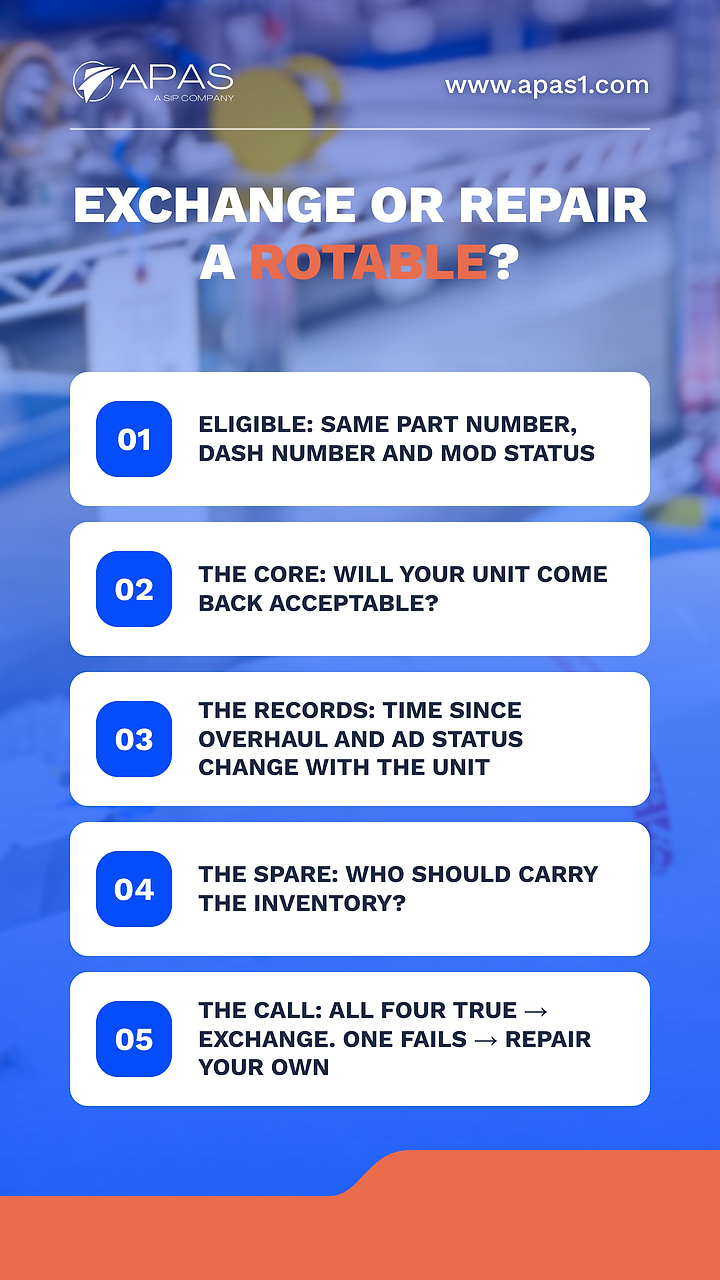
Exchange is the right answer when four things are true at once: the unit offered is eligible for your aircraft, your core is likely tore turn in acceptable condition, the time saved is worth more than the records you give away, and carrying your own spares for that part number makes little sense.
1. The incoming unit is eligible, not just the same part. Same part number is the starting point. Dash number, modification status and service bulletin standard also have to match what your aircraft and your maintenance program allow. The FAA's guidance on replacement parts eligibility places that determination on the installer, before the aircraft returns to service with the part installed. Airworthiness directives follow the unit too: under 14 CFR § 39.7, operating a product that does not meet an applicable directive is a violation, whoever owned the unit before.
2. Your core is likely to come back acceptable. Exchange terms usually make the condition of the core you return part of the final cost. A unit removed for a minor, well-understood fault is a reasonable bet. A unit with damage that may exceed published limits, or that could be declared beyond economical repair, can turn a quick exchange into an open-ended bill.
3. The time saved outweighs the history you give away. For an air carrier, 14 CFR § 121.380 lists records that have to be kept, among them the time since last overhaul of items overhauled on a specified time basis, the status of life-limited parts and the status of applicable airworthiness directives. When you exchange a unit, those records change with it. An incoming unit with less time remaining to its next overhaul brings the next removal forward.
4. Someone else should carry the inventory. If only a few of your aircraft use a part number, a spare on your own shelf is capital that may wait years. An exchange or a pool spreads that cost across many operators. A large fleet with frequent removals of the same unit may find its own spares cheaper.
When repairing your own unit is the better call
Repair and return is the better call when your unit carries something an exchange cannot give back, and when the schedule can absorb the time. Typical cases are a recently overhauled unit, a configuration few others share, damage that published data already covers, or a part number with no eligible exchange unit available.
A planned removal is the clearest case. If the work fits inside a check, waiting for your own unit costs little and keeps a history you already know. Scope matters too: the difference between repair and overhaul can change the length of the repair cycle, so settle it before the unit ships, so settle it before the unit ships.
How each option changes the time to return to service
Exchange shortens the time the aircraft waits, not the time the repair takes. With your own unit, the aircraft waits for induction, bench time, engineering decisions and logistics, which are the four stages where repair weeks go.With an exchange, it waits for shipping and installation.
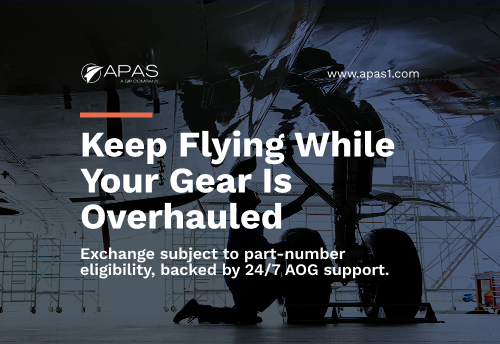
That gap matters most on assemblies with long shop visits. A landing gear exchange during overhaul shows the effect on one component family: the aircraft is down for the installation window, while its own gear goes through the shop on a separate schedule. When the aircraft is already on the ground, round-the-clock component support follows the same logic.
What travels with an exchange unit
An exchange unit arrives with its release document and its records, and both deserve the same review as a unit you bought outright. Check that the paperwork matches the serial number on the data plate, that it supports the eligibility conditions above, and that your records system can absorb the change in time since overhaul and directive status before installation.
Repair, exchange and parts management from one desk
When repairs, exchanges and parts purchases sit with different vendors, the decision above tends to go to whoever answers first. Keeping parts management and rotable exchange services next tocomponent repair lets the choice be made on the merits: one team can quote the repair of your unit and check whether an eligible exchange unit exists for the same part number. At APAS, exchange is available subject to part-number eligibility, alongside outright sales and lease options.
Making the call before the next removal
Exchange or repair is not a choice between fast and slow. It is a choice about which unit you want on the aircraft, with which history, and who pays to keep the spare waiting. The four conditions can be checked for your critical part numbers long before the next removal, so the decision is already made when the unit comes off. Eligibility is the place to start: part number, dash number and modification status.
Frequently asked questions
Do I get my own unit back after an exchange? Usually not. In a standard exchange the unit you receive becomes yours, and the core you return goes into the provider's stock after repair. If keeping your own unit matters, because of its records or its configuration, ask for a loan while yours is repaired. A loan keeps your unit's history, under terms of its own.
Is an exchange unit new? Generally not. An exchange unit is a serviceable rotable restored in the past, carrying its own time since overhaul and repair history. What matters is not whether it is new but whether it is eligible for your aircraft, released with the right paperwork, and recorded in a way your maintenance program can absorb.
Can an exchange unit have a different modification status than mine? It can, and that is why eligibility goes beyond the part number. A unit at a different modification or service bulletin standard may or may not be interchangeable with yours. The answer comes from your illustrated parts catalog and your engineering department, and it should be settled before the unit ships, not at installation.
Rethink Repairs. Reclaim Your Budget.
Explore how DER Repairs from APAS can reduce costs, speed up turnaround, and extend component life—without compromising safety or compliance.

.png)