FAA Form 8130-3 and Part 145 Release: A Block-by-Block Guide
FAA Form 8130-3 explained block by block: what a Part 145 maintenance release certifies, what it does not, and what your inspector, lessor and buyer check.

.png)
FAA Form 8130-3 explained block by block: what a Part 145 maintenance release certifies, what it does not, and what your inspector, lessor and buyer check.
An FAA Form 8130-3 is the signed record that travels with a component after maintenance: it identifies the unit, states what was done to it and against which data, and names the certificate holder who approved it for return to service under 14 CFR Part 43. It is a maintenance record in portable form, and the first page anyone reads before trusting the part.
The form arrives in the box, gets filed, and is rarely read again until someone needs it. That someone is usually not the person who received it. It is a quality inspector before installation, a lessor when the aircraft goes back, or a buyer years later when the unit is sold. Each one reads the same page for a different reason. The release is written once and read for the life of the part, so the time to check it is the day it arrives.
FAA Form 8130-3, the Authorized Release Certificate, Airworthiness Approval Tag, has two halves. The left side, block 13, certifies new articles produced under Part 21. The right side, block 14, approves an article for return to service after maintenance, repair or alteration under Part 43. On a maintenance release, the left side is shaded out.
The form and the FAA guidance set two limits. The 8130-3 does not authorize installation on a particular aircraft: the installer still makes that decision and that record. And it is not a shipping document.
One change is worth knowing, because much of what ispublished still cites the old reference. Since late 2025, the instructions forusing the form as a maintenance release live in AC43-9D, Maintenance Records and FAA Form 8130-3 Return to Service. FAA Order 8130.21J now covers only Part 21 uses, and it canceled Order8130.21H, the version many guides still quote.
A Part 145 repair station may approve an article for return to service only if the article is within its ratings and the work followed approved data or data acceptable to the FAA. That condition sits in 14 CFR145.201, and it is why the release is only as good as the capability behind it. A shop's list of rated part numbers is where that check starts.
FAA guidance calls the form recommended. What the rules regulate is its content. Under 14 CFR 43.9, a maintenance record must describe the work or reference acceptable data, give the completion date, and carry the signature, certificate number and kind of certificate of the person approving it. The repair station must also give the owner or operator a copy of the maintenance release. The8130-3 is the standard way to do both on one page that inspectors recognize. It closes the path a component follows through a repair shop,after test and before shipping.
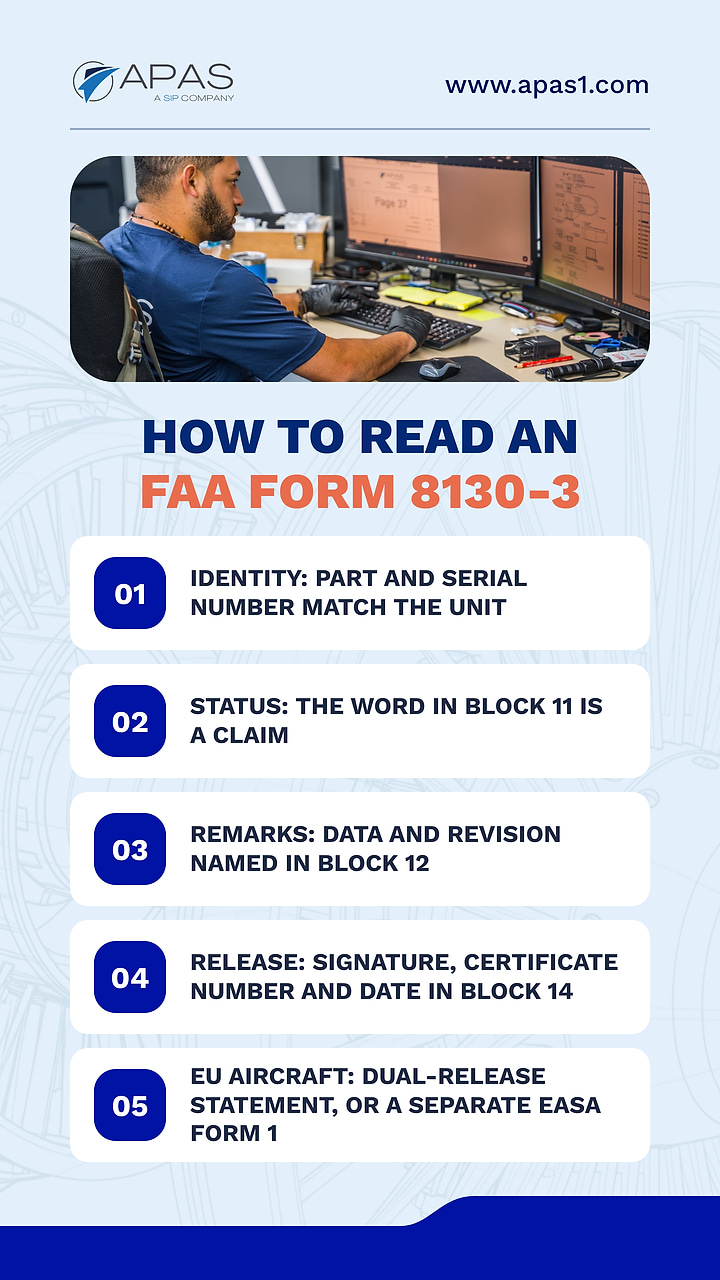
Most of the form is identification. Five areas carry theweight on a maintenance release.
· Block 3: form tracking number. A unique number lets anyone trace the form back to the issuer's copy, and lets attachments point back to the form.
· Blocks 7, 8 and 10: description, part number, serial number. They must match the unit in your hand. When the markings on the part are worn or removed, the form can serve as its primary identification, which makes a mismatch more serious, not less.
· Block 11: status/work. One status term: overhauled, repaired, inspected and/or tested, or modified. Each term has a defined meaning in the guidance. "Inspected" or "tested" is not "overhauled", and every later reader will treat the unit according to that word.
· Block 12: remarks. The block that answers "according to what?". It should name the data used and its revision level, the airworthiness directives and service bulletins complied with, life-limited part status where it applies, any parts manufacturer approval (PMA) parts installed and any deviation from the work order. A repair on data approved through a Designated Engineering Representative is referenced here like any other approved data.
· Block 14:the release itself. Which regulation the work meets, the authorized signature, the certificate number of the repair station, and the date.
The same form serves three readers who arrive at different moments. The table puts them side by side.
Two points follow from the table. First, a correctable error is cheap on the day it arrives: the guidance lets the originator reissue a form to fix administrative errors, referencing the original. Years later, the originator may be harder to reach. Second, all three readers usually start with the paper, not the physical part, and the paper often decides whether the part gets a second look. What a complete package looks like on one component family shows the records behind a release in practice.
EASA Form 1 is the European Authorized Release Certificate. An 8130-3 can work for both systems only as a dual release: the facility must hold both FAA Part 145 and EASA Part-145 approvals, be rated for the article when it releases it, and be located in the United States or an EU member state. It marks block 14a as the guidance specifies and adds an EASA release statement with its EASA approval number in block 12. A facility that does not meet those conditions issues two separate forms.
A dual release is not interchangeability by default. If the unit may end up on an EU-registered aircraft, look for that statement in block12. Without it, the European system recognizes the form only in the special cases that the bilateral guidance lists. The differences between FAA and EASA certification explain why the two authorities still ask for their own wording.
An 8130-3 is not paperwork about the repair: it is the part of the repair that outlives the bench. Four checks at receiving cover most of what the inspector, the lessor and the buyer will ask later. Match the identification to the unit, read the status word, confirm the data and revision in the remarks, and verify the signature and certificate number in block 14. If a unit may cross into the European system, add the dual-release statement. Where the records are kept matters too. Searchable, digital maintenance records make the next reader's job shorter.
Can a lost or incorrect 8130-3 be replaced? Yes, within limits. The originator can issue a copy of a lost or damaged form once the form is correlated with the article, and can reissue a form to correct administrative errors. A reissued form refers to the original and is not a new statement of the article's condition.
How long does a repair station keep 8130-3 records? A Part 145 repair station must keep the records that demonstrate compliance with Part 43 for at least two years from the date the article was approved for return to service. The owner's copy has a longer working life, because it travels with the unit to every later inspector, lessor and buyer.