When to Overhaul Your Landing Gear: Planning Around Intervals to Avoid AOG
How to read your landing gear overhaul interval, understand hard time vs on condition, and plan removal early to avoid an avoidable landing gear AOG.
A landing gear overhaul is never a surprise. It is a scheduled event, written into the aircraft's maintenance program long before it comes due.
The operators who avoid a landing-gear AOG are the ones who planned the removal, the shop slot and the schedule protection well ahead of time.
Here is how to read your intervals and plan around them.
Intervals Are Set by the Maintenance Program
The point at which landing gear must be overhauled is not a shop decision, and it is not an industry rule of thumb. It is defined by the OEM and the aircraft's approved maintenance program.
Depending on the component and aircraft, that interval may be expressed in calendar time, in cycles or landings, or in a combination of both.
Because the controlling number varies by part number and application, the practical takeaway is simple: read your own maintenance program and manufacturer documentation for the assembly in question.
APAS works to that approved data rather than to any generic figure, which is why an evaluation always starts from your specific part number and aircraft.
Hard Time Versus On Condition
Landing gear is commonly governed as a hard-time item. The assembly must come off and be overhauled when it reaches the defined limit, regardless of how good it looks.
That is different from an on-condition component, which stays in service as long as inspection shows it within limits.
Knowing which philosophy applies to your gear — and to the individual life-limited parts inside it — is essential to planning.
A hard-time limit is a firm date on the horizon. Treating it as flexible is how operators back themselves into an avoidable grounding.
Hard time
On condition
What governs removal
A defined limit in the approved maintenance program
The result of inspection against manual limits
Expressed in
Calendar time, cycles or landings — or a combination
Measured condition at the time of inspection
Does appearance matter?
No. The limit applies regardless of how good the part looks
Yes. Condition is what keeps it in service
How landing gear is usually managed
This one — gear and its life-limited parts are commonly hard-time
Applies to some surrounding components, not the gear assembly
Planning implication
A firm date on the horizon: book the slot and the schedule protection ahead
Watch the trend and act when a finding approaches a limit
What goes wrong
Treating a firm limit as flexible — that is how an avoidable AOG happens
Missing the trend between inspections
Reading the Signals Between Overhauls
Even with a fixed overhaul interval, the gear sends signals between shop visits that deserve attention.
Catching a condition early can mean a planned repair instead of an unplanned removal.
Planning the Removal Ahead of Time
A landing gear removal ties up the aircraft, so it rewards early planning.
Aligning the overhaul with a scheduled heavy check, arranging the shop slot in advance, and confirming documentation and approved data are all far easier with lead time than under pressure.
Lead time also opens options. Booked ahead, an overhaul can be sequenced so the aircraft is down only for the installation window — particularly when an exchange or serviceable unit is part of the plan.
Left to the last moment, the same job turns into a scramble.
How Exchange Protects the Schedule
One of the most effective ways to plan around an overhaul interval is to decouple the aircraft's downtime from the shop's turnaround.
With an exchange or serviceable unit, the aircraft receives a ready assembly while its own gear is overhauled on a separate timeline.
APAS supports exchange inventory subject to part-number eligibility, so it is worth confirming eligibility for your specific part number early in planning.
When exchange is available for your application, it converts a long shop turnaround into a much shorter installation event. A dedicated article in this series covers it in detail.
Where APAS Fits Into Overhaul Planning
APAS handles landing gear overhaul and repair as an FAA and EASA Part 145 repair station, with a Landing Gear rating and more than 30 years in component MRO.
Bringing the shop into your planning early lets the evaluation, the data review and any exchange discussion happen before the interval forces your hand.
To begin, send the part number, serial number, aircraft application and requested service.
AOG support is available 24/7 for the cases that do slip through. But the goal of good planning is to keep the gear out of that queue in the first place.
FAQ
How is the landing gear overhaul interval determined?
The landing gear overhaul interval is determined by the OEM and the aircraft's approved maintenance program. It may be expressed in calendar time, cycles or landings, or a combination. Because it varies by part number and application, operators should read their own maintenance documentation rather than rely on a generic figure.
How do I know when to overhaul landing gear?
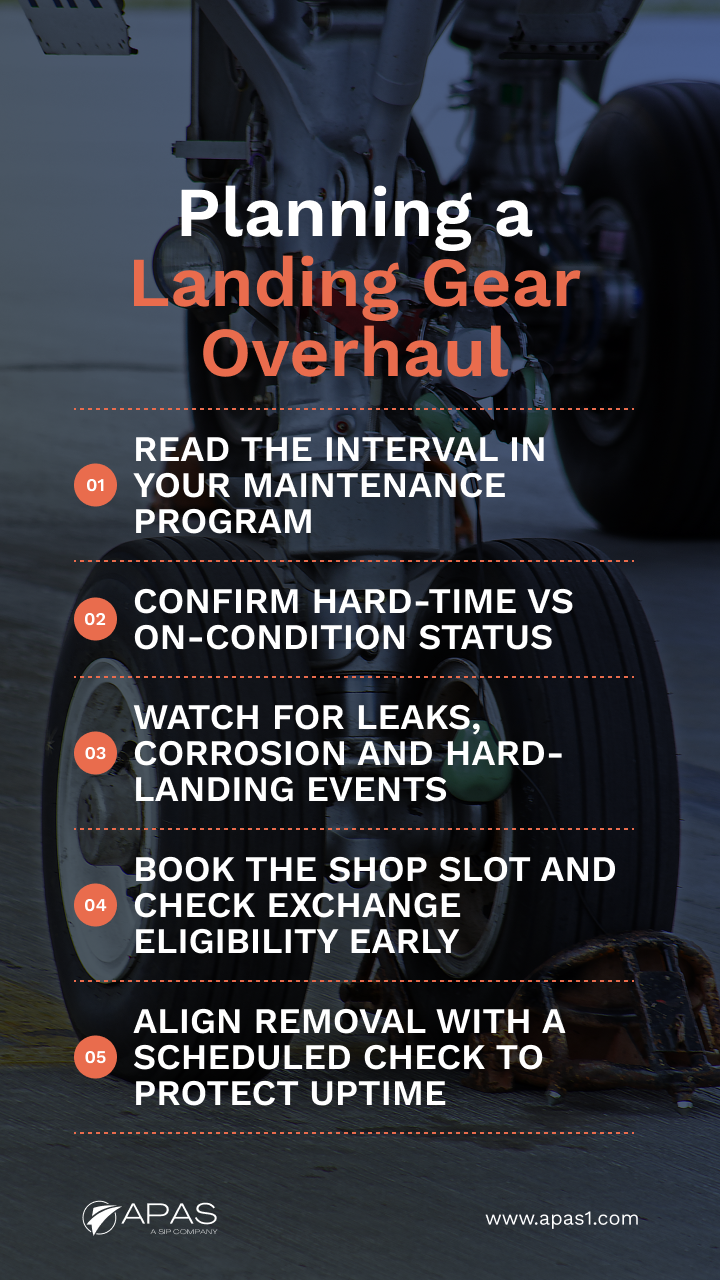
You know when to overhaul landing gear by following the limit defined in your maintenance program for that specific assembly, then planning the removal ahead of that point. Between overhauls, conditions such as leaks, corrosion or hard-landing events may trigger earlier inspection or repair.
What is the difference between hard time and on condition for landing gear?
A hard-time landing gear must be removed and overhauled at a defined limit regardless of apparent condition. An on-condition item stays in service as long as inspection keeps it within limits. Landing gear and its life-limited parts are commonly managed as hard-time, so the limit is a firm date to plan around.
Does a landing gear life limit mean the whole assembly is scrapped?
No. A landing gear life limit typically applies to specific life-limited parts that are replaced at overhaul, while the wider assembly is restored through inspection and approved repair. Reaching a life limit drives replacement of those parts, not automatic scrapping of the entire gear.
How far ahead should landing gear overhaul planning and removal start?
Landing gear overhaul planning should start well before the interval comes due, so the shop slot, documentation and any exchange unit can be arranged with lead time. Early planning lets the removal align with a scheduled check and keeps the event from becoming an avoidable AOG.
Rethink Repairs. Reclaim Your Budget.
Explore how DER Repairs from APAS can reduce costs, speed up turnaround, and extend component life—without compromising safety or compliance.

.png)