Maintenance Trends & Industry Insights
Component MRO Checklist: 12 Questions Before You Sign
A component MRO checklist for buyers: 12 questions on capability, approvals, release paperwork, turnaround and warranty, and what a good answer sounds like.

.png)
A component MRO checklist for buyers: 12 questions on capability, approvals, release paperwork, turnaround and warranty, and what a good answer sounds like.
Qualifying a component MRO means confirming, before thefirst unit ships, that a repair station is allowed, equipped and organized toreturn your specific part number to service: on data your authority accepts,with paperwork your lessor will accept, on a clock you can plan around. Acertificate on the wall answers only the first part.
A shop can hold the right approvals and still not have yourunit on its capability list, send part of the work out, or quote a turnaroundthat leaves out the weeks you care about. None of that shows up in a brochure.It shows up in the answers to twelve questions, short enough to ask at a boothor on a first call, each with what a good answer sounds like.
The twelve questions fall into four groups: capability andapprovals, paperwork and turnaround, how the work is run, and what happens whenthe plan changes. The table is the version to print or screenshot; the sectionsbelow explain what to listen for.
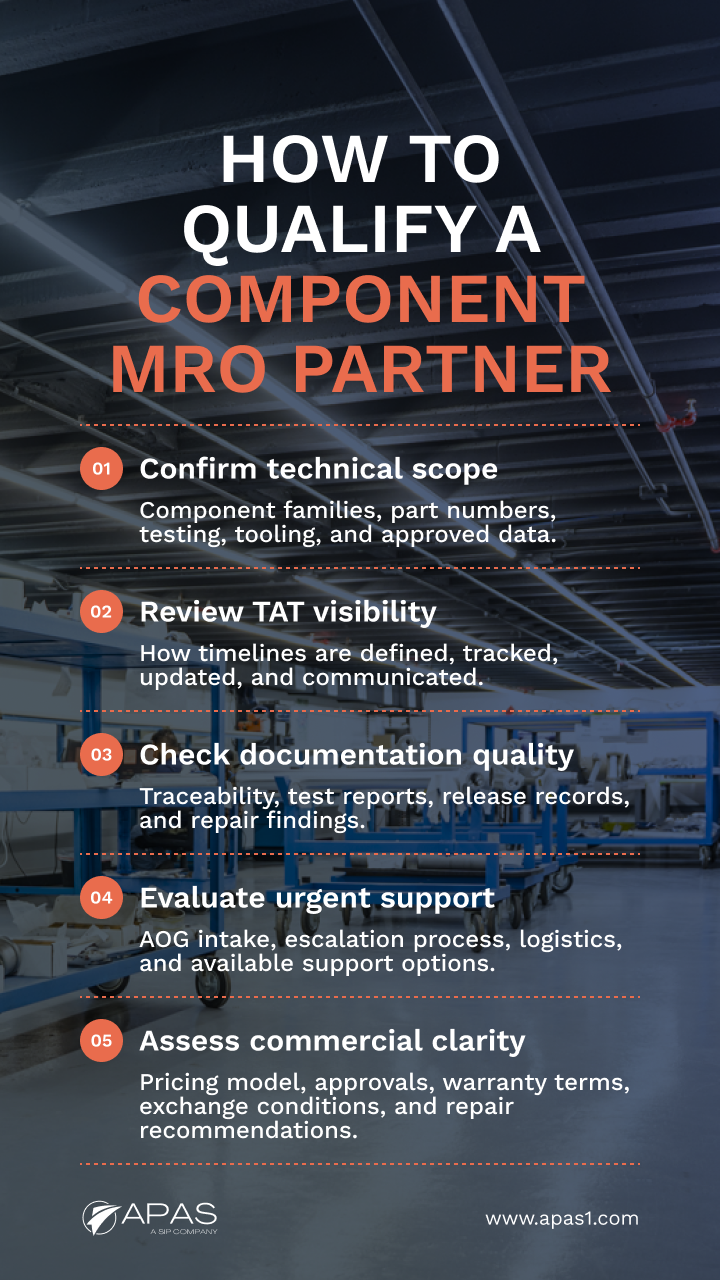
A repair station's ratings define categories of work, its capability list names the units, and approved data defines what may legally be done to the damage in front of you. The first three questions check that all three line up for your part number.
Under 14 CFR § 145.215, a station with a limited rating may work on an article only if it appears on a current capability list or on its operations specifications. An article is added only after a documented self-evaluation of facilities, equipment, technical data and trained personnel. A good answer is your part number, found on the list. "We can evaluate it" is honest too, but it describes a self-evaluation that has not happened yet, and that work runs on your clock. It pays to check a part number against the capability list before the unit ships.
The approval that matters is the one your aircraft's registry recognizes. A US repair station that also holds EASA Part-145 approval can return a component to service with a dual release on FAA Form 8130-3. The FAA's advisory circular on maintenance records and Form8130-3 states that an article released that way is eligible for installation on a US-or EU-registered aircraft. A good answer names the approvals and confirms that your part number falls within each of them. The differences between FAA and EASA certification are worth knowing before that conversation.
Sooner or later a finding falls outside the published limits, and the answer that comes back is "replace only". A shop that works strictly inside the manual will scrap the unit or return it unrepaired. A shop with an engineering route can ask whether approved data can be developed for that damage, through the design approval holder or through a Designated Engineering Representative acting within their delegated limits. A good answer names the route and who approves the data. It also admits that developing new data runs on a different schedule from a repair that already has it.
These three questions decide what the unit is worth when it returns, and when it actually returns. Most disputes over turnaround and paperwork are definitions nobody settled before the purchase order.
The release document is what allows the next person to install the unit, and what a lessor or a buyer will read years later. Ask which form it will be, whether it is a single or a dual release, and what the remarks will say about the work performed and the data used. Form 8130-3 records the airworthiness status of the article. It is not a shipping document, and on its own it does not approve installation on a particular aircraft. What a complete package looks like on one component family is a useful reference point.
Two shops can quote the same number of days and mean very different things, because one is quoting the bench and the other the whole trip. Ask when the clock starts, on receipt or on work-order release. Ask when it stops, at release or at delivery. And ask whether it pauses while a finding waits for an engineering decision. A good answer states all three without being prompted. Where the weeks in a component repair actually go breaks the cycle into its four stages.
When the aircraft cannot wait for its own unit, the question is availability, not repair speed. An exchange puts a serviceable unit on the aircraft now, while yours goes through the shop on its own clock. A good answer covers three points: whether your part number and modification status are eligible, what condition your returned core has to meet, and what paperwork travels with the unit you receive. Exchange terms vary from one program to the next, so ask for them in writing before you need them.
These questions test the organization behind the certificate. A capable bench inside a shop that cannot tell you who has your unit, or where it went, will still cost you time.
Subcontracting is normal and legal. Not knowing about it is the problem. Under 14 CFR § 145.217, a repair station may contract a maintenance function to an outside certificated facility when the FAA approves that function for contracting. The station must also keep a record of which functions go to which outside facility, and what certificate each facility holds. A good answer names the functions sent out for your part number, such as plating, nondestructive testing or a specific test, and how much time each one adds to the cycle.
"In work" is not a status. A useful status says which stage the unit is in, from induction and teardown to approval, repair, test, release and shipping, and whether a decision is waiting on you. A good answer shows how that status reaches you and how often it updates. It also says what triggers a message without you asking: a finding that changes the scope, apart on backorder, a failed test. If the only way to know is to call, plan on calling.
Repairs stall in handoffs: between receiving and engineering, between engineering and the quote, between the quote and your approval. One accountable person who can see the whole file shortens every one of them. A good answer is a name, a direct line and the person who covers when that contact is out. If your fleet keeps several units in work at once, ask whether the same contact can report across all of them, rather than one workorder at a time.
Most shops sound alike on a routine repair. The last three questions test the day something goes wrong: bad findings, an aircraft already on the ground, a repaired unit that comes back.
"Beyond economical repair" is a commercial judgment made on technical findings, and you are entitled to see both. A good answer is a written teardown report: the findings, the cost to repair against the value of the unit, and the alternatives considered. Those include a different scope, such as an overhaul instead of a repair or the reverse, approved data for the damage, or replacement. Without the report, a BER decision is impossible to challenge and hard to learn from. Ask, too, what happens to the unit and its records afterward.
A round-the-clock claim is easy to print. Ask what happens at 2 a.m. on a Sunday: who answers, whether that person can check stock and capability, and who can authorize a shipment. A good answer describes the path a request follows and the information the shop needs first, which is usually the part number, serial number, aircraft registration, the defect and the station. It also says how the first reply reaches you. Then ask when that path was last used, and how it went.
Warranty terms are rarely read until they are needed. Ask what is covered, workmanship, replaced parts or both, and when the period starts, at release or at installation. Ask whether it runs on calendar time or on flight hours. Then ask how a claim works: who pays for transport, how a unit returned under warranty is tested, and what happens when the shop finds no fault. A good answer is a written policy you receive before the first purchase order, not after the first claim.
No shop will answer all twelve perfectly. What the check list does is turn a conversation about reputation into a comparison of specific answers, and the pattern worth watching is precision. A shop that names the part number, the form, the route and the person is describing a process it already runs. A shop that answers in adjectives is describing an intention. Qualify the repair station before the unit is on your critical path, not after. If your part number is the open question, send it to the APAS team with the serial number, the defect and the records you have.
At MRO Europe 2026? APAS will be at RAI Amsterdam, Booth 1-910, on Wednesday, October 28, and Thursday, October 29. Bring a part number. Leave with options.
How long does it take to qualify a component MRO? It depends mostly on your own supplier approval process: the audit requirements, the documentation your quality team reviews, the component categories in scope and the contract itself. The twelve questions shorten the first step, because they surface gaps before an audit is scheduled rather than during it. A shop that answers them in writing gives your quality team something concrete to verify.
Should a new component MRO be piloted before a full contract? Often, yes. Starting with a limited scope, such as selected component families or units without schedule pressure, lets you test communication, documentation, repair quality and status visibility on real work. That way the relationship proves itself before it has to carry an AOG, and the twelve answers can be checked against what actually happened.
What documents should we request from a component MRO up front? The approval certificates and operations specifications, the capability list, a sample release package for a part number you operate, the quality manual sections that cover contract maintenance, the warranty policy and the name of the technical contact. A sample package says more than any description of one, because it shows exactly what will come back with your unit.