What Is a Ram Air Turbine? RAT Maintenance and the 20-Year Service Interval
Learn what a Ram Air Turbine does, when RAT maintenance may be due, and how APAS supports repair, overhaul, testing, modification, exchange and AOG needs.
What Is a Ram Air Turbine? RAT Maintenance and the 20-Year Service Interval
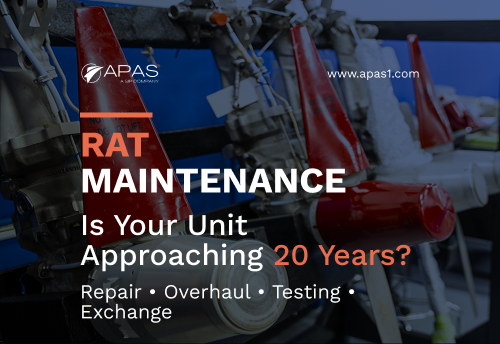
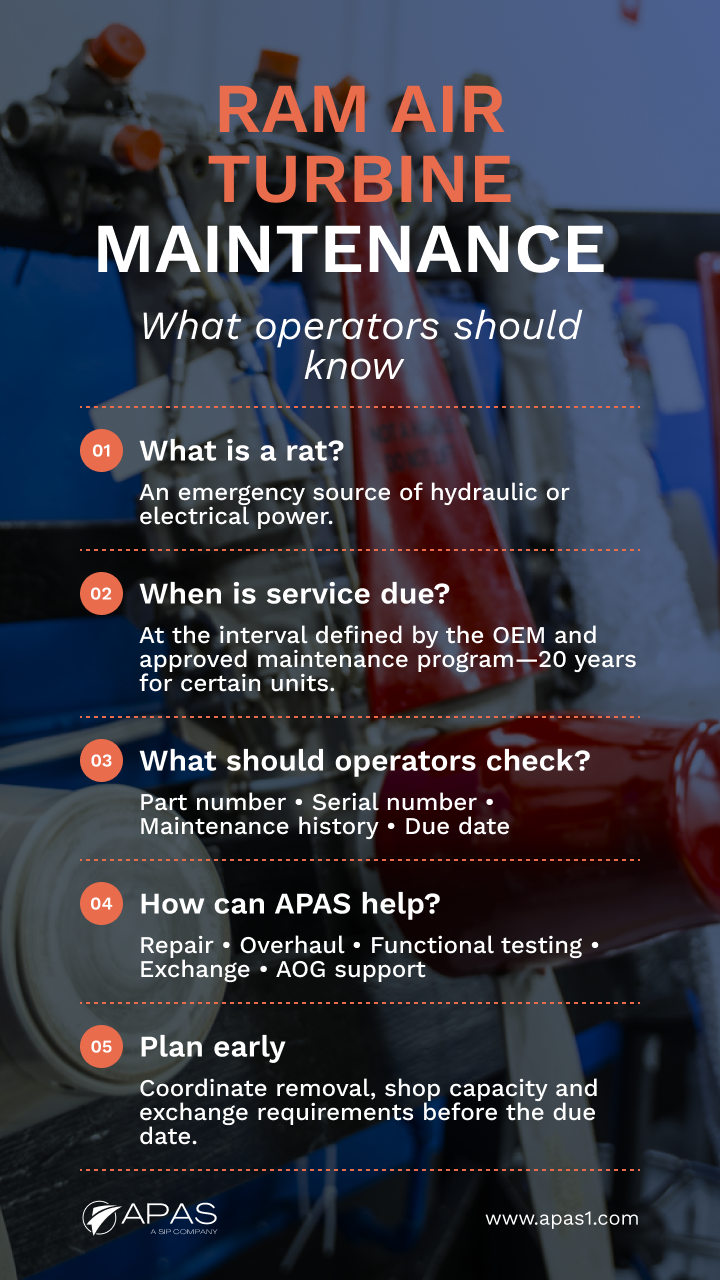
A Ram Air Turbine, commonly known as a RAT, is an emergency aircraft component designed to deploy into the external airflow when required. As the turbine rotates, it can help generate emergency hydraulic power, electrical power, or both, depending on the aircraft and RAT configuration.
During normal aircraft operations, the RAT typically remains stowed. However, it must be ready to perform when primary power sources are unavailable. Its limited use does not eliminate the need for maintenance. Calendar age, OEM requirements, Airworthiness Directives, Service Bulletins and the operator’s approved maintenance program may determine when a RAT must be inspected, tested, repaired, overhauled or modified.
For certain RAT units, scheduled maintenance may become due at a 20-year calendar interval. Operators approaching this milestone should identify affected units early and plan maintenance requirements before the due date.
When Is a Ram Air Turbine Deployed?
A RAT may deploy automatically or be activated manually, depending on the aircraft design and operating conditions.
Once deployed, airflow turns the turbine and enables it to support designated emergency systems. Depending on the installation, this may include emergency hydraulic power, electrical power, or a combination of both.
The RAT is not intended to replace the aircraft’s primary power systems during routine operations. Its purpose is to provide essential backup capability under specific emergency conditions.
Because it is an emergency component, reliability is critical. The fact that a RAT may remain stowed for many years does not mean that its condition can be assumed without inspection, testing and scheduled maintenance.
When Does a RAT Require Maintenance?
There is no single maintenance interval that applies universally to every RAT. Requirements can vary according to:
configuration requirements or modification status.
For certain units, scheduled RAT maintenance may be required after 20 years of service. The applicable requirement must be confirmed using the approved maintenance data associated with the specific unit and aircraft program.
Operators should not wait until the component reaches its due date to begin planning. Removal scheduling, shop capacity, transportation, documentation review, testing requirements and exchange availability can all affect the maintenance timeline.
Why Does Calendar Age Matter?
A RAT may spend most of its service life in the stowed position, but its internal parts, seals, lubrication, mechanical assemblies and deployment functions can still be affected by time and environmental exposure.
Calendar-based maintenance provides an opportunity to evaluate whether the unit remains within the applicable condition and performance requirements. Depending on the unit and approved maintenance instructions, the work may involve inspection, repair, overhaul, modification and full functional performance testing.
This is particularly important because the RAT must perform when called upon. Its reliability cannot depend only on how frequently it has been used.
RAT Inspection, Repair, Overhaul, Modification and Testing
The service required depends on the unit’s condition, maintenance history, aircraft application and applicable technical instructions.
RAT inspection
Inspection evaluates the component for visible condition, damage, wear, configuration status and other findings covered by the applicable maintenance data. Documentation and component identification may also be reviewed before work begins.
RAT repair
Repair addresses eligible findings using approved technical data and procedures. The required work depends on the condition of the unit, repair limits and the applicable part number.
RAT overhaul
An overhaul involves a more comprehensive maintenance scope intended to return the unit to the condition and performance standards defined by the applicable approved data. This may include disassembly, detailed inspection, repair or replacement of eligible components, reassembly, testing and documentation.
RAT modification
Some RAT maintenance events may involve compliance with Airworthiness Directives, Service Bulletins or modifications between configurations. Operators should confirm whether the unit requires AD/SB compliance, configuration change or other approved modification work before induction.
Functional testing
Functional testing helps verify that the RAT performs according to the requirements established for the unit. Testing requirements and acceptance criteria depend on the RAT configuration, manufacturer and approved maintenance instructions.
APAS supports RAT services with in-house air tunnel testing capabilities, allowing functional performance testing to be coordinated as part of the repair, overhaul or modification process when applicable.
RAT exchange
When maintenance timing could affect aircraft planning, an exchange unit may provide an alternative to waiting for the original component to complete the shop process. Availability and eligibility must be confirmed for the required part number and aircraft application.
What Should Operators Review Before the 20-Year Interval?
Early preparation starts with identifying which RAT units may be approaching their scheduled maintenance requirement.
Operators should review:
part number;
serial number;
aircraft platform;
manufacturing date;
installation date, when applicable;
last overhaul or maintenance date;
maintenance records;
applicable OEM requirements;
relevant ADs and SBs;
configuration status;
scheduled removal date;
required return-to-service date;
exchange or replacement needs;
AOG risk or operational urgency.
This information helps the maintenance provider confirm capability, review the requested scope and identify documentation or planning requirements before the component arrives.
Why Early RAT Maintenance Planning Matters
Waiting until the maintenance interval is close can create unnecessary operational pressure. A delayed decision may affect component removal, shop capacity, transportation, documentation, testing and exchange-unit availability.
Early coordination allows operators to:
identify affected units across the fleet;
align removals with scheduled maintenance events;
confirm provider capability by part number;
prepare the required technical records;
evaluate repair, overhaul, testing, modification or exchange options;
account for transportation and customs requirements;
reduce the risk of an avoidable maintenance bottleneck.
For fleets with multiple aircraft of a similar age, several RAT units may approach the same calendar milestone within a relatively short period. Reviewing fleet exposure early can support more orderly capacity, budget and component planning.
APAS RAT Maintenance Support
APAS provides Ram Air Turbine testing, repair, overhaul and modification solutions for commercial aviation operators. Its RAT support includes repair and overhaul services, AD/SB compliance support, configuration modifications, functional performance testing, exchange inventory availability and 24/7 AOG response capability.
A key differentiator of APAS’ RAT capability is its in-house air tunnel testing, a specialized resource available in only a limited number of repair facilities. This allows APAS to support functional performance testing as part of the RAT repair, overhaul or modification process when applicable.
APAS also supports RAT work with experienced technicians, engineering support and certified quality control. RAT capabilities are available for selected Airbus fleets, including A320, A319, A321 and A330 aircraft.
Support is evaluated according to the RAT part number, aircraft application, requested service and applicable technical requirements. Operators should provide the available component and maintenance information so APAS can confirm capability and recommend the appropriate next step.
For urgent requirements, exchange inventory and AOG response support may help address time-sensitive component needs, subject to part-number eligibility and availability.
Information to Include in a RAT Service Request
To request RAT maintenance, overhaul, testing, modification or exchange support, operators should provide:
part number and serial number;
aircraft type;
reason for removal;
requested service;
reported condition or findings;
available maintenance history;
applicable due date;
AD/SB or modification requirement, if applicable;
required turnaround;
shipping origin and destination;
exchange or AOG requirement, if applicable.
Complete information supports a faster initial evaluation and helps avoid delays caused by missing records or unclear service requirements.
Frequently Asked Questions
Does every RAT require maintenance after 20 years?
Not necessarily. A 20-year interval may apply to certain RAT units, but requirements vary by model, part number, OEM instructions and the operator’s approved maintenance program.
Does a RAT require maintenance if it has never been deployed?
It may. Maintenance can be driven by calendar time and approved program requirements rather than deployment history alone.
What is the difference between RAT repair and overhaul?
Repair addresses eligible findings within the applicable approved limits. Overhaul involves a broader maintenance scope defined by the approved technical data for the unit.
Can RAT maintenance include AD or SB compliance?
Yes, depending on the applicable requirements. Some RAT maintenance events may involve Airworthiness Directive compliance, Service Bulletin incorporation or configuration modification work.
Why is functional testing important?
Functional testing helps verify that the RAT performs according to the requirements established for the unit. The exact testing process depends on the RAT configuration, manufacturer and approved maintenance instructions.
Can APAS provide RAT exchange support?
APAS offers RAT exchange inventory availability subject to part-number eligibility and unit availability.
What aircraft fleets does APAS support for RAT services?
APAS’ RAT capability materials identify support for selected Airbus fleets, including A320, A319, A321 and A330 aircraft. Operators should confirm eligibility by part number before induction.
What should an operator send to confirm APAS capability?
The operator should provide the RAT part number, serial number, aircraft application, requested service, maintenance due date, applicable AD/SB requirement and available component history.
Plan Before the RAT Maintenance Due Date
A RAT may remain out of sight during routine operations, but it remains an essential emergency component. For units approaching a 20-year maintenance interval, early planning can help operators coordinate removal, documentation, shop capacity, testing, exchange requirements and any applicable compliance work.
Is your RAT approaching its scheduled maintenance interval? Contact APAS with the part number, serial number, required service date and maintenance requirement to confirm capability and plan the appropriate repair, overhaul, testing, modification or exchange support.
Rethink Repairs. Reclaim Your Budget.
Explore how DER Repairs from APAS can reduce costs, speed up turnaround, and extend component life—without compromising safety or compliance.

.png)