DER Repairs on Landing Gear: Approved Alternative Repairs That Extend Value
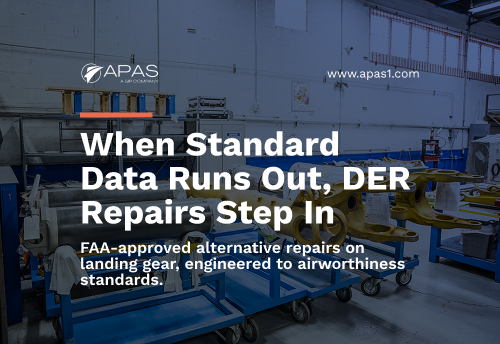
How DER repairs on landing gear provide FAA-approved alternative repairs that extend value, using approved data as an alternative to costly replacement.
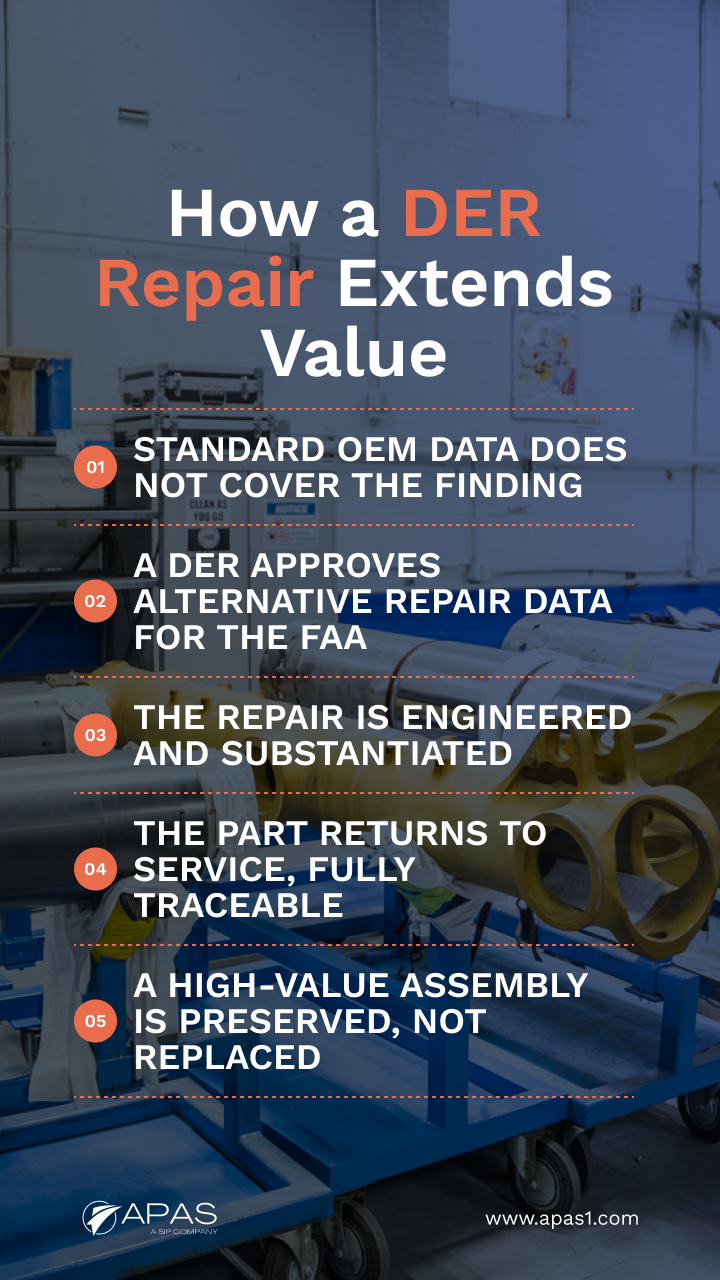
A DER repair is an FAA-approved alternative repair, used when the manufacturer's standard data does not cover the condition found on a part. It lets a shop restore a landing gear component — with full engineering substantiation — instead of defaulting to an expensive replacement.
Not every landing gear finding is covered by standard repair data. When it is not, the default answer is usually a new part.
Here is what a DER repair is, and when it helps.
What a DER Repair Is
DER stands for Designated Engineering Representative: an individual authorized to approve engineering data on behalf of the FAA.
A DER repair is an FAA-approved alternative repair, supported by approved data, used when the standard OEM component maintenance manual does not cover the specific condition found on a part.
The key point: a DER repair is not a workaround, and it is not a shortcut around the rules.
It is a formally approved repair with its own engineering substantiation and approved data — a legitimate, documented way to return a part to service that the standard manual alone would not permit.
Why Landing Gear Is a Strong Candidate for DER Repairs
Landing gear parts are large, high-value, precisely machined structural components.
When such a part develops a condition that standard data does not address, replacement can be costly and — depending on availability — slow.
That combination of high part value and gaps in standard coverage is exactly where an approved alternative repair earns its place.
And because the gear is structural and safety-critical, the substantiation behind any repair matters enormously. A DER repair provides that rigor, which is why it is a credible route for landing gear specifically, not a generic cost-saving tactic.
When a DER Repair Comes Into Play
A DER repair is considered when a finding falls outside the standard manual and standard repairs do not apply.
Rather than moving straight to replacement, the shop evaluates whether an approved alternative repair can restore the part within airworthiness requirements.
How Approved Data Keeps It Airworthy
The value of a DER repair rests entirely on its approved data.
The repair is engineered and substantiated, then approved, so the returned part meets airworthiness requirements just as a standard repair would. Nothing about the alternative path lowers the standard the part must meet.
For the operator, that means a DER repair carries the same expectation of documentation and traceability as any other approved work.
The repair, the data behind it and the return to service are all recorded against the part number and serial number, keeping the assembly fully auditable.
DER Repair as an Alternative to Replacement
DER repair
Replacement
Approval basis
Engineering data approved by a Designated Engineering Representative on behalf of the FAA
The part's own approved production data
When it applies
The standard manual does not cover the condition, and the part can be restored within airworthiness limits
No approved repair path exists, or the defect is beyond recovery
Airworthiness standard
Identical — a DER repair meets the same requirements as any approved repair
The standard for a new or serviceable part
What the operator keeps
The high-value assembly already in service
The value moves to a new part
Documentation
Repair, its approved data and the release recorded against P/N and S/N
Traceability of the replacing part
Not guaranteed
Some findings still require replacement — each case is evaluated individually
—
The practical appeal is that a DER repair can preserve a serviceable, high-value assembly that would otherwise be replaced.
When approved data supports restoring the part, the operator keeps the value already invested in that component instead of absorbing a full replacement.
This is not a promise that every condition can be repaired. Some findings will still require replacement, and the controlling factor is always whether an approved repair path exists.
What a DER capability adds is another legitimate option to evaluate before defaulting to a new part.
How APAS Applies DER Repair to Landing Gear
APAS offers DER repair as one of its four service lines, alongside MRO, AOG 24/7 and repair management.
It holds a Landing Gear rating as an FAA and EASA Part 145 repair station, with more than 30 years in component MRO. That lets a DER repair be evaluated inside the same shop that performs the landing gear overhaul and inspection.
To have a condition assessed, send the part number, serial number, aircraft application and requested service.
Where standard data does not cover a finding, APAS can evaluate whether an approved alternative repair path applies — before replacement is assumed.
Frequently Asked Questions (FAQ)
What is a DER repair on landing gear?
A DER repair on landing gear is an FAA-approved alternative repair, supported by approved data, used when the standard OEM manual does not cover a specific condition on the part. It lets a shop restore and return the part to service with full engineering substantiation rather than defaulting to replacement.
What does designated engineering representative repair mean?
A designated engineering representative repair is a repair whose engineering data is approved by a DER acting on behalf of the FAA. It provides an approved, documented path to fix a condition that falls outside standard manufacturer data, while still meeting airworthiness requirements.
Is a DER repair in aviation a safe alternative to replacement?
Yes. A DER repair in aviation must meet the same airworthiness requirements as any approved repair, because it is engineered, substantiated and approved through approved data. It is an alternative to replacement, not a lowering of the standard the part must meet.
How does landing gear repair approval work through approved data?
Landing gear repair approval through approved data means the repair is substantiated and formally approved before the part is returned to service, whether under standard OEM data or a DER-approved alternative. The repair and its data are recorded against the part number and serial number for traceability.
When is a DER repair a better alternative to replacement for landing gear?
A DER repair can be the better alternative when a landing gear part has high value, the standard manual does not cover the condition, and an approved alternative repair can restore it within airworthiness limits. Whether it applies depends on the specific finding and the available approved data, so each case is evaluated individually.
Rethink Repairs. Reclaim Your Budget.
Explore how DER Repairs from APAS can reduce costs, speed up turnaround, and extend component life—without compromising safety or compliance.

.png)