RAT AOG Support: What to Have Ready for an Urgent Request
When an aircraft is on ground (AOG), every hour counts. A component that keeps the aircraft from flying — a Ram Air Turbine (RAT) among them — turns a…

.png)
When an aircraft is on ground (AOG), every hour counts. A component that keeps the aircraft from flying — a Ram Air Turbine (RAT) among them — turns a…
When an aircraft is on ground (AOG), every hour counts. A component that keeps the aircraft from flying — a Ram Air Turbine (RAT) among them — turns a routine maintenance question into an urgent, high-pressure decision. In that moment, the difference between a fast recovery and a long delay often comes down to something simple: how prepared the operator is when they reach out. So what should you have ready before you send a RAT AOG request?
An AOG request is a clock that starts the moment the aircraft can't fly. Much of the time lost in those first hours is not spent working on the component — it is spent going back and forth to confirm what the unit is, what it needs, and where it has to go. Every missing detail is another message, another wait, another delay before real work can begin.
The fastest path is a complete first request. When the shop receives everything it needs up front, it can move straight to confirming capability and defining the next step — instead of chasing information. Preparation doesn't just help the shop; it directly shortens the time your aircraft spends on the ground.
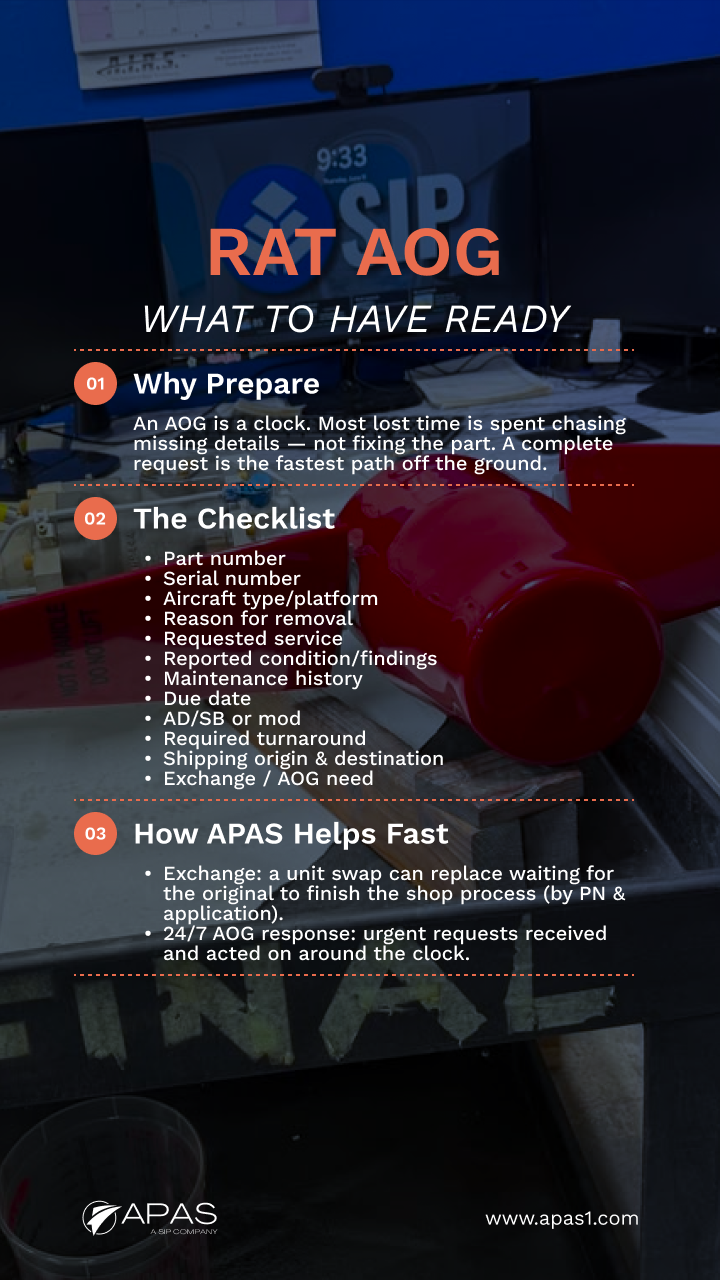
Before you send an urgent RAT request, gather the following. This is exactly the information APAS uses to move quickly and confirm the right service — especially in an AOG situation:
Not sure you have every field? Send what you have and flag it as AOG. A partial-but-clear request that's marked urgent still moves faster than waiting until everything is perfect.
Sometimes the maintenance timeline itself is the problem: waiting for the original unit to complete the shop process would hold up the aircraft. This is where two capabilities matter most.
Once APAS receives your request, the team confirms capability by part number and application and recommends the next step — repair, overhaul, modification, or, when timing calls for it, an exchange path. Because APAS is an FAA & EASA Part 145 facility with in-house engineering support and testing, the work stays coordinated under one roof, reducing hand-offs when they matter most. RAT support is available for selected Airbus fleets, including A320, A319, A321, and A330 aircraft, subject to part-number review.
You can't always predict an AOG. You can control how ready you are for one. A complete request — part number, serial number, platform, condition, due date, shipping, and any exchange or AOG need — is the single most effective thing an operator can do to shorten time on the ground.
Facing a RAT AOG right now? Reach APAS 24/7 with your part number, serial number, aircraft application, and requested service, and our team will confirm capability and move on to the next step immediately. For time-sensitive needs, exchange inventory may help, subject to part-number eligibility.
For the full picture of RAT maintenance — repair, overhaul, modification, exchange and testing — see our complete guide: "Ram Air Turbine Repair and Testing: What Operators Should Know." (enlace al PILAR)
Have the part number, serial number, aircraft type/platform, reason for removal, requested service, reported condition or findings, available maintenance history, applicable due date, any AD/SB or modification requirement, required turnaround, shipping origin and destination, and any exchange or AOG requirement. This is exactly the information APAS uses to move quickly and confirm the right service. A complete first request lets the shop move straight to confirming capability and defining the next step instead of chasing information.
An AOG request is a clock that starts the moment the aircraft can't fly, and much of the time lost in those first hours is spent going back and forth to confirm what the unit is, what it needs, and where it has to go. Every missing detail is another message, another wait, another delay before real work can begin. A complete request directly shortens the time your aircraft spends on the ground.
Send what you have and flag it as AOG. A partial-but-clear request that's marked urgent still moves faster than waiting until everything is perfect. The goal is to give the shop enough to confirm capability and define the next step without delay.
Sometimes waiting for the original unit to complete the shop process would hold up the aircraft. In that case, an exchange unit can be an alternative to waiting for your original unit to finish. Eligibility and availability are confirmed by part number and application, which is why the part number belongs at the top of your request.
APAS provides 24/7 AOG response, so a time-critical RAT request can be received and acted on when it happens rather than the next morning. As an FAA & EASA Part 145 facility with in-house engineering support and testing, the work stays coordinated under one roof, reducing hand-offs when they matter most. RAT support is available for selected Airbus fleets, including A320, A319, A321 and A330 aircraft, subject to part-number review.