How Is a Ram Air Turbine Tested? Inside APAS In-House Wind Tunnel Testing
A Ram Air Turbine (RAT) may spend most of its service life stowed and unused. But when it is finally called upon, it has to work on the first try. That…
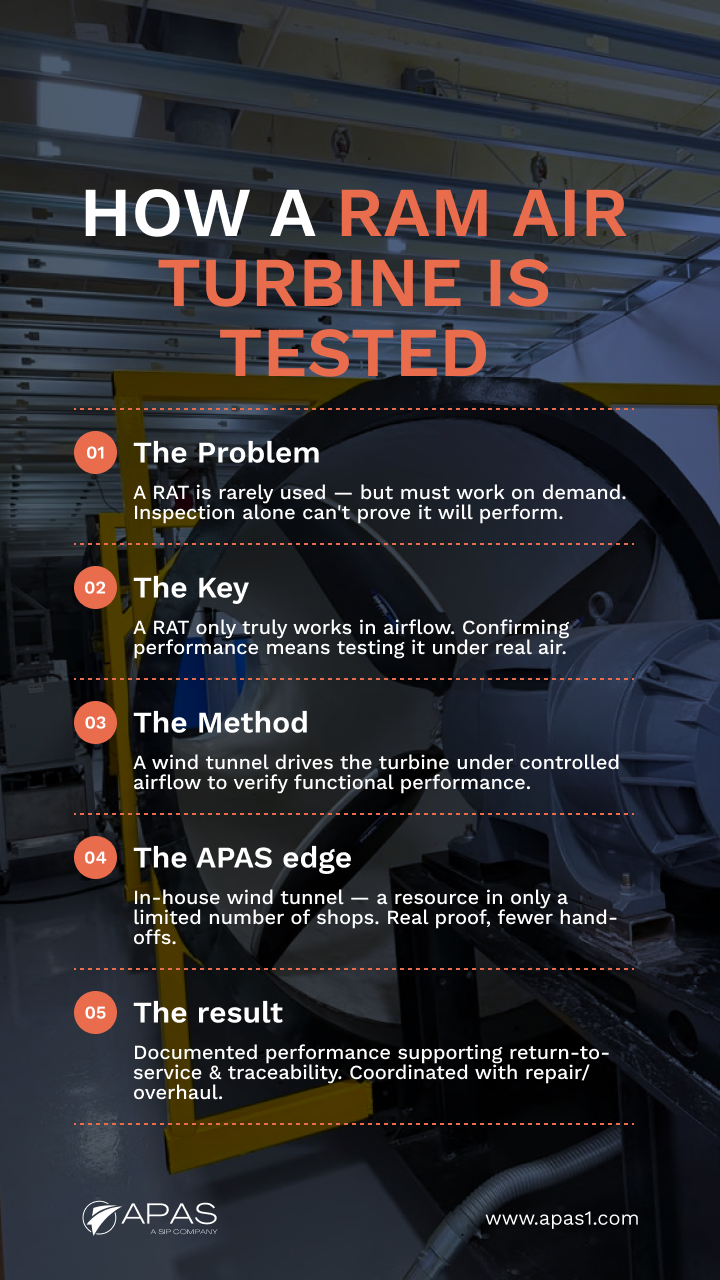
A Ram Air Turbine (RAT) may spend most of its service life stowed and unused. But when it is finally called upon, it has to work on the first try. That single fact is what makes testing one of the most important — and most misunderstood — parts of RAT maintenance. So how is a Ram Air Turbine actually tested, and why does the way it is tested matter so much?
Why a RAT has to be tested, not just inspected
A visual inspection can confirm the condition of a component. It cannot, on its own, confirm that the unit will perform when it deploys. A RAT is an emergency device: it extends into the airstream and, as the turbine turns, supports emergency hydraulic power, electrical power, or both, depending on the aircraft and RAT configuration. Because its whole purpose is to deliver power under specific emergency conditions, its reliability cannot be assumed from appearance or maintenance history alone. It has to be demonstrated.
This is why functional testing sits at the center of RAT work. Functional testing helps verify that the unit performs according to the requirements established for that specific configuration, manufacturer, and approved maintenance instructions.
The challenge: a RAT only truly works in airflow
Here is what makes RAT testing different from many other components: a RAT is designed to be driven by air. To confirm real performance, you need to reproduce the condition it was built for — moving air across the turbine — in a controlled, repeatable way. A bench check has its place, but confirming functional performance under airflow is a different capability altogether.
How wind tunnel testing works — and why APAS built one in-house
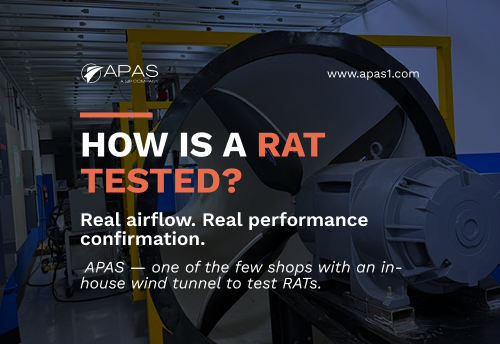
A wind tunnel provides controlled airflow so the turbine can be driven and its functional performance evaluated in conditions that reflect how it operates. This is where APAS stands apart: APAS is one of the few shops with an in-house wind tunnel to test RATs — a specialized resource available in only a limited number of repair facilities.
Doing this in-house matters for two practical reasons:
Real performance confirmation, not just paperwork. The unit is evaluated under real airflow, so the result reflects how it will actually behave — proof that it will deploy and perform, not just an assumption.
Fewer hand-offs, tighter timelines. When testing is coordinated in the same facility as repair, overhaul or modification, the unit does not have to travel to a separate test provider — removing a step and the delay that comes with it.
Where testing fits in the RAT process
Functional performance testing is not a stand-alone event. At APAS, it is coordinated as part of the repair, overhaul, or modification process when applicable. The testing requirements and acceptance criteria depend on the RAT configuration, manufacturer and approved maintenance instructions — and the results are documented to support return-to-service and traceability. In other words, the unit leaves the shop proven, documented, and ready.
What operators should ask about RAT testing
When evaluating a provider for RAT support, a few questions cut to the point:
Is functional performance testing available in-house, or is it outsourced?
Is testing aligned with the applicable technical requirements for the specific part number and configuration?
Are results documented in a way that supports return-to-service and traceability?
Can testing be coordinated together with repair, overhaul, or modification to protect turnaround?
The bottom line
For an emergency component, "it looks fine" is not the same as "it will work." Testing a RAT under real airflow is how that gap is closed — and having that capability in-house is what lets APAS confirm performance and keep timelines under control at the same time.
Have a RAT approaching testing or overhaul? Send APAS the part number, serial number, aircraft application, and requested service, and our team will confirm capability and recommend the next step. For time-sensitive needs, exchange inventory and 24/7 AOG support may help, subject to part-number eligibility. RAT capabilities are available for selected Airbus fleets, including A320, A319, A321, and A330 aircraft.
How is a Ram Air Turbine tested before it goes back on the aircraft?
A RAT is validated through functional performance testing, not visual inspection alone, because its whole purpose is to deliver emergency power on demand. Since a RAT is designed to be driven by air, confirming real performance means reproducing moving airflow across the turbine in a controlled, repeatable way. The testing requirements and acceptance criteria depend on the RAT configuration, manufacturer, and approved maintenance instructions.
Why isn't a visual inspection enough for RAT functional testing?
A visual inspection can confirm the condition of a component, but it cannot on its own confirm that the unit will perform when it deploys. A RAT is an emergency device whose reliability cannot be assumed from appearance or maintenance history alone, so it has to be demonstrated. That is why functional testing sits at the center of RAT work.
What is wind tunnel testing for a RAT and why does it matter?
A wind tunnel provides controlled airflow so the turbine can be driven and its functional performance evaluated in conditions that reflect how it actually operates. This gives real performance confirmation rather than just paperwork, so the result reflects how the unit will behave when called upon. Confirming functional performance under airflow is a different capability from a standard bench check.
Does APAS offer in-house RAT testing, or is it outsourced?
APAS is one of the few shops with an in-house wind tunnel to test RATs, a specialized resource available in only a limited number of repair facilities. Keeping testing in the same facility as repair, overhaul, or modification means fewer hand-offs and tighter timelines, since the unit does not have to travel to a separate test provider. This is what lets APAS confirm performance and keep timelines under control at the same time.
How does RAT performance testing fit with RAT repair and overhaul?
At APAS, functional performance testing is not a stand-alone event; it is coordinated as part of the repair, overhaul, or modification process when applicable. The results are documented to support return-to-service and traceability, so the unit leaves the shop proven, documented, and ready. RAT capabilities are available for selected Airbus fleets, including A320, A319, A321, and A330 aircraft, subject to part-number eligibility.
Rethink Repairs. Reclaim Your Budget.
Explore how DER Repairs from APAS can reduce costs, speed up turnaround, and extend component life—without compromising safety or compliance.

.png)