RAT Documentation & Traceability: What Operators Should Expect
On a Ram Air Turbine, the work is not finished when the last task is signed off on the bench. It is finished when the documentation is complete. For an…

.png)
On a Ram Air Turbine, the work is not finished when the last task is signed off on the bench. It is finished when the documentation is complete. For an…
On a Ram Air Turbine, the work is not finished when the last task is signed off on the bench. It is finished when the documentation is complete. For an emergency component, the records that leave the shop with the unit are not paperwork for its own sake — they are the proof that the work was done to approved data, and the reason the unit can be returned to service with confidence. So what should an operator actually expect in a RAT documentation package, and why does traceability matter so much?
A RAT spends most of its service life stowed and unused, then has to perform on demand. That single fact raises the stakes on every claim made about the unit. A visual result or a verbal assurance is not enough — the operator, the regulator and the next shop all need to be able to see what was done, how, and against which approved data.
That is what traceability provides: the ability to follow the history and the work of a specific unit — part number, serial number, and the record of what happened to it — from receipt through return-to-service. Good documentation is what makes that history visible and defensible. It supports airworthiness, it supports return-to-service, and it stands up when an audit asks the question later.
A complete documentation package tells the full story of the unit in a way that anyone can follow after the fact. In general terms, an operator should expect it to include:
Taken together, these pieces are what let an operator trust the unit without having to be in the shop to watch the work happen.
Return-to-service is not a formality at the end — it is a statement that the work was performed to approved data and that the unit is fit to fly. That statement is only as strong as the records behind it. When identification, work performed, approved data reference, compliance evidence and test results all line up, the release documentation rests on a complete chain.
The same chain is what protects the operator during an audit. Months or years later, the question is rarely "was the work good?" — it is "can you show it?" A unit with clear, connected records answers that question quickly. A unit with gaps does not, regardless of how well the physical work was done. This is why traceability is a quality outcome, not a clerical one.
When evaluating a shop for RAT support, the documentation is worth asking about directly — before the unit ships, not after:
At APAS, the work — inspection, repair, overhaul, modification and testing — is performed to approved data and documented, with certified quality control and engineering support behind it. Functional testing is documented to support return-to-service and traceability, so the unit leaves the shop not only serviceable, but provable.
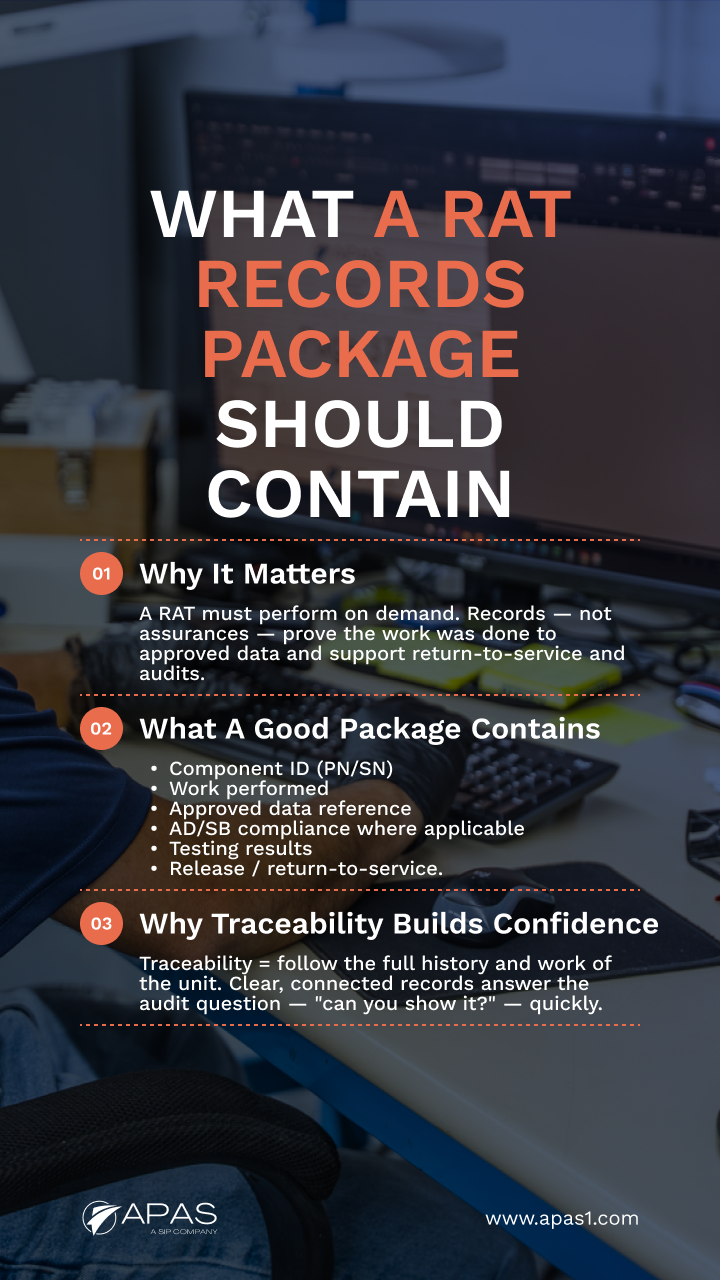
For an emergency component, "the work was done" and "the work can be shown" are not the same thing — and only one of them survives an audit. A complete, traceable records package is what turns a repaired RAT into a unit that an operator can put back on the aircraft with confidence.
Preparing a RAT for repair, overhaul, or exchange? Send APAS the part number, serial number, aircraft application, and requested service, and our team will confirm capability and the documentation you can expect on return. RAT support is available for selected Airbus fleets, including A320, A319, A321 and A330 aircraft, subject to part-number eligibility, with 24/7 AOG support for time-sensitive needs.
For the full picture of RAT maintenance — inspection, repair, overhaul, modification, testing and exchange — see our complete guide: "Ram Air Turbine Repair and Testing: What Operators Should Know."
A RAT spends most of its service life stowed and unused, then has to perform on demand, which raises the stakes on every claim made about the unit. Traceability is the ability to follow the history and work of a specific unit, by part number and serial number, from receipt through return-to-service. It supports airworthiness and return-to-service, and it stands up when an audit asks the question later.
In general terms, an operator should expect component identification by part number and serial number, a clear description of the work performed, a reference to the approved data used, evidence of AD/SB compliance where applicable, testing and functional performance results, and the release / return-to-service documentation. Taken together, these pieces let an operator trust the unit without having to be in the shop to watch the work happen.
A complete record should point to the approved data and maintenance instructions under which the work was carried out, not just state that the work was completed. When identification, work performed, approved data reference, compliance evidence, and test results all line up, the release documentation rests on a complete chain. That is what makes the unit's history visible and defensible.
Return-to-service is a statement that the work was performed to approved data and that the unit is fit to fly, and that statement is only as strong as the records behind it. Months or years later, the question is rarely "was the work good?" but "can you show it?" A unit with clear, connected records answers that quickly, while a unit with gaps does not, regardless of how well the physical work was done.
Ask whether the records will clearly identify the unit by part number and serial number, reference the approved data the work was performed against, evidence AD/SB compliance where it applies, and document functional testing results to support return-to-service, and whether quality control is certified and built into the process. At APAS, the work is performed to approved data and documented, with certified quality control and engineering support behind it, so the unit leaves the shop not only serviceable but provable.