RAT Repair vs. Overhaul: How to Know Which Your Unit Needs
When a Ram Air Turbine (RAT) comes off the aircraft for shop work, one of the first questions an operator or planner faces is deceptively simple: does…

.png)
When a Ram Air Turbine (RAT) comes off the aircraft for shop work, one of the first questions an operator or planner faces is deceptively simple: does…
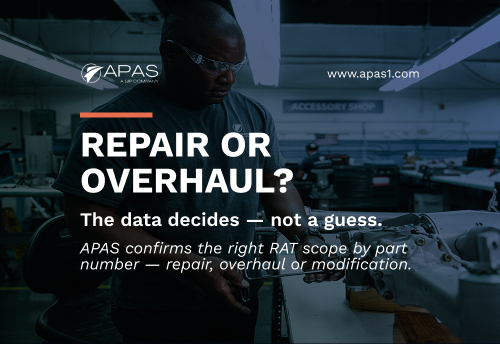
When a Ram Air Turbine (RAT) comes off the aircraft for shop work, one of the first questions an operator or planner faces is deceptively simple: does this unit need a repair, or a full overhaul? The answer shapes cost, downtime and documentation — so it is worth understanding early. And the honest answer is that it is not a preference you choose from a menu. It is a determination based on the unit's condition and the approved technical data applicable to it.
The two terms are often used loosely, but in a Part 145 environment, they describe different scopes of work.
A repair addresses eligible findings using approved data and procedures, within the applicable repair limits and in accordance with the part number. In other words, a repair is targeted: it corrects what is found to be out of tolerance or defective, using the methods the approved data allows for that specific unit.
An overhaul is a broader scope intended to return the unit to the condition and performance standards defined by the approved data. It may include disassembly, detailed inspection, repair or replacement of eligible components, reassembly, testing and documentation. An overhaul restores the unit to a defined standard, rather than only addressing the specific findings in front of the technician.
Put simply: a repair fixes what needs fixing; an overhaul brings the unit back to a defined baseline. Both are valid, and both have their place — the right one depends on the unit itself.
Which service applies is not decided by budget or schedule alone. It depends on a combination of factors, all read together:
Because these factors interact, two units that look similar on the outside can genuinely need different scopes of work. That is normal — and it is why the determination is made against the data, not by assumption.
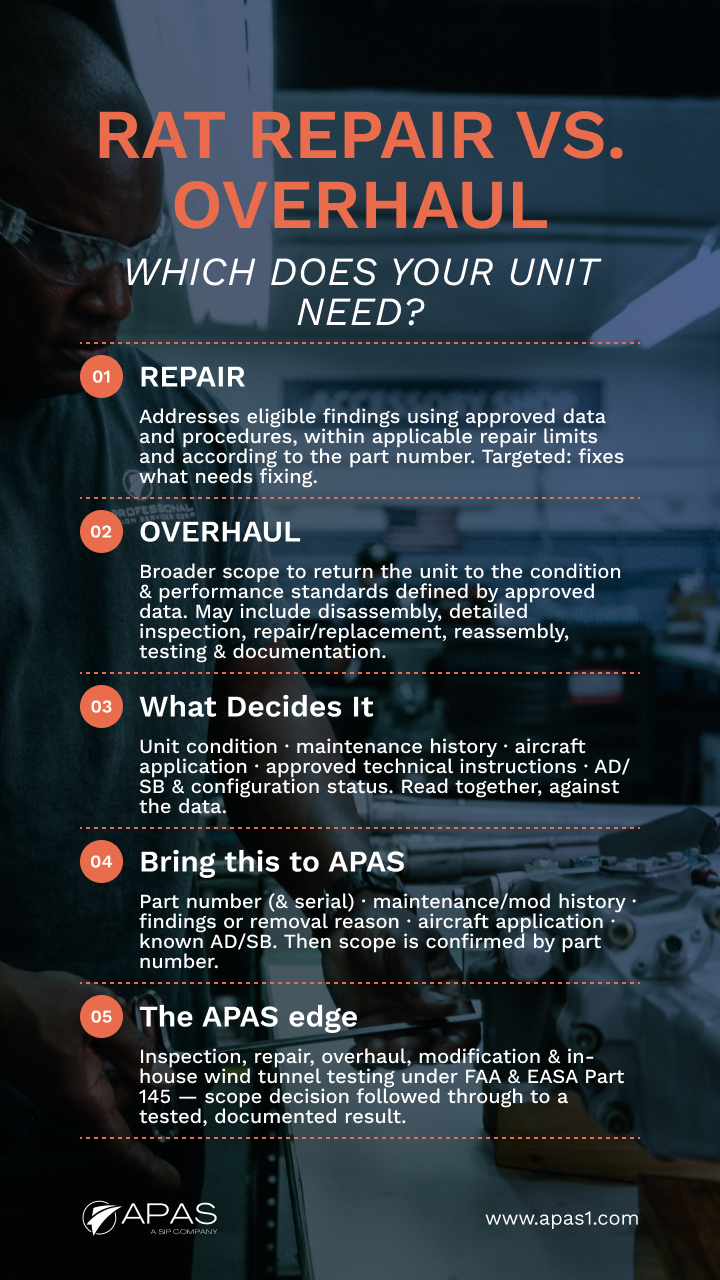
The single most important step an operator can take is to bring the part number and the unit's records to the conversation early. To confirm the applicable scope by part number, it helps to have:
With that in hand, APAS can review eligibility and confirm whether a repair, overhaul or modification is the right path for that specific unit — subject to part-number eligibility. RAT capabilities are available for selected Airbus fleets, including A320, A319, A321, and A330 aircraft, subject to review by part number.
Repair and overhaul are only as strong as the capabilities that support them. APAS offers RAT inspection, repair, overhaul, modification, AD/SB compliance, and configuration modifications under FAA & EASA Part 145 approvals, backed by more than 30 years in component MRO. And because APAS is one of the few shops with an in-house wind tunnel to test RATs, functional performance can be confirmed as part of the same process — so the scope decision is followed through to a tested, documented result. For time-sensitive situations, strategic exchange inventory and 24/7 AOG support may help keep an aircraft moving, subject to part-number eligibility.
Repair or overhaul is not a guess and not a preference — it is a determination driven by condition, history, application and approved data. The fastest way to a clear answer is to send APAS the part number and records and let the eligibility review confirm the scope for your specific unit.
For the full picture of RAT maintenance — intervals, repair, overhaul, modification, testing and exchange — see our complete guide: "Ram Air Turbine Repair and Testing: What Operators Should Know."
In a Part 145 environment, they describe different scopes of work. A RAT repair is targeted: it addresses eligible findings using approved data and procedures, within the applicable repair limits and according to the part number. A ram air turbine overhaul is a broader scope intended to return the unit to the condition and performance standards defined by the approved data.
An overhaul restores the unit to a defined baseline rather than only addressing the specific findings in front of the technician. It may include disassembly, detailed inspection, repair or replacement of eligible components, reassembly, testing and documentation. Put simply, a repair fixes what needs fixing, while an overhaul brings the unit back to a defined standard.
The determination is driven by the unit's condition, its maintenance history, the aircraft application, the approved technical instructions, and AD/SB and configuration status, all read together. Because these factors interact, two units that look similar on the outside can genuinely need different scopes of work. It is decided against the approved data, not by budget, schedule, or assumption.
The single most important step is to bring the part number and serial number, along with the unit's maintenance and modification history where available, any known findings or removal reason, the aircraft application and configuration details, and any AD/SB considerations already known to apply. With that in hand, APAS can review eligibility and confirm whether a repair, overhaul or modification is the right path for that specific unit, subject to part-number eligibility.
APAS offers RAT inspection, repair, overhaul, modification, AD/SB compliance and configuration modifications under FAA & EASA Part 145 approvals, backed by more than 30 years in component MRO. Because APAS is one of the few shops with an in-house wind tunnel to test RATs, functional performance can be confirmed as part of the same process. RAT capabilities are available for selected Airbus fleets, including A320, A319, A321 and A330 aircraft, subject to review by part number.