MRO Parts Sourcing: New, USM, PMA or Rotable Exchange?
New, used serviceable, PMA or rotable exchange: compare where a replacement part comes from and what proof of eligibility must travel with each before you buy.
MRO Parts Sourcing: New, USM, PMA or Rotable Exchange?
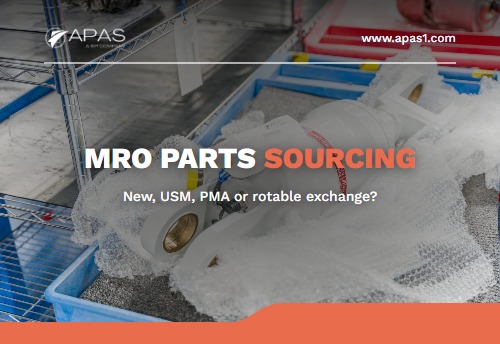
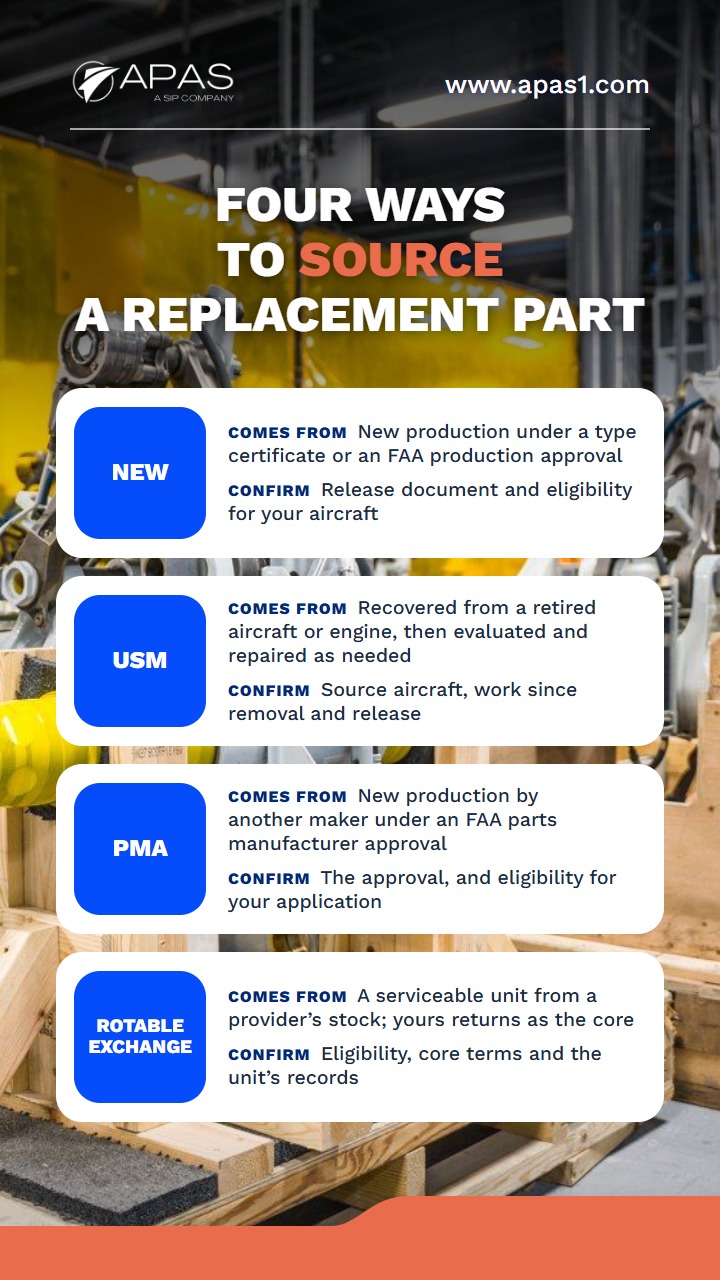
MRO parts sourcing is the decision about where a replacement component comes from and what proof comes with it: a new part produced under a type certificate or an FAA production approval, used serviceable material (USM) recovered from retired aircraft, a part made under a parts manufacturer approval (PMA), or a serviceable rotable from exchange. The paperwork and the wait differ for each.
When a finding rules out repair, buyers often compare these paths on price alone. The better comparison asks first: can the part be installed on this aircraft, and can we prove it?
Why does the sourcing path matter once repair is off the table?
Because replacement is only faster if a part is actually available and eligible. An MRO chief executive quoted in AviTrader MRO 360° (October 2026, p. 39) said that when replacement is the better option but no serviceable rotable is available in the market, the delay can become much more significant. His conclusion was that access to multiple solutions matters: being able to weigh repair, Designated Engineering Representative (DER) alternatives, replacement components and available serviceable material rather than relying on a single path.
Market conditions push the same way. The same issue (p. 21) reported a USM distributor dismantling a record number of aircraft and engines as demand grows for lower-cost parts available immediately, and Aviation Week reported on October 8, 2026 that limited availability of OEM parts is driving a growing PMA market. Here "OEM" is a commercial word for the original supplier, not a regulatory category.
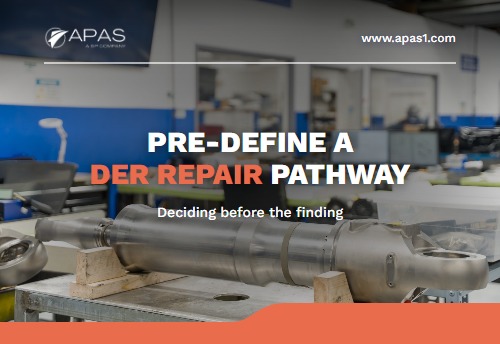
Keep more than one path open before you need it. Our guide on how operators evaluate repair versus replacement covers the repair side of that decision; [how to pre-define your DER repair pathway]([[URL blog #2]]) covers the engineering side.
New, USM, PMA or rotable exchange: how do the four paths differ?
Path
Where it comes from
What to confirm
Often fits when
New
New production by or for the type certificate holder, under a type certificate or an FAA production approval
Release document, and eligibility for your aircraft
You need a unit with no prior service history
USM
Recovered from a retired aircraft or engine, then evaluated and, where needed, repaired or overhauled
Source aircraft, work performed since removal and release
A serviceable unit with prior hours is acceptable
PMA
New production by a manufacturer other than the type certificate holder, under an FAA parts manufacturer approval and typically its own part number
The approval itself, and that the part is eligible for your application
An approved alternate part number exists for the application
Rotable exchange
A serviceable rotable from a provider's stock, with your removed unit returned as the core
Eligibility, core terms and the unit's records
Time on the ground costs more than the history you give up
New parts. Under 14 CFR 21.9, a replacement article likely to be installed on a type-certificated product may not be produced unless it falls under a listed category. The first two are production under a type certificate or under an FAA production approval.
USM. A distributor quoted by AviTrader (p. 21) described the shape of the path: its new processing center will receive, document and evaluate components recovered from dismantling, then send them to approved MRO facilities, with serviceable components distributed after repair or overhaul. For a buyer, the proof is a chain: where the part came from, and what was done to it since.
PMA. Under 14 CFR 21.303, a PMA applicant must submit the article's design with the test reports and computations showing it meets airworthiness requirements, and must show the article conforms to that design. A PMA is a production approval, not a lesser grade of part and not a regulatory "OEM alternative." A parts marketplace quoted in the same issue (p. 37) said its cross-reference tool can surface alternate or PMA numbers when a part is unavailable under its original number.
Rotable exchange. You receive a serviceable unit now, and your removed unit goes back as the core. The decision turns on eligibility, core condition, the records you trade and who carries the spare, as we explain in choosing between rotable exchange and repair.
What documents and checks should travel with each path?
Every path needs the same three things: proof of eligibility for your aircraft, proof of the part's condition, and a traceable history. The FAA's AC 20-62E gives guidance on determining the quality, eligibility and traceability of aeronautical parts intended for installation on U.S. type-certificated products.
In practice, ask these questions before you accept a unit from any source:
Do the part number, dash number and modification status match what your aircraft and maintenance program allow?
Which release document comes with it, such as an FAA Form 8130-3 or an EASA Form 1, and does it match the serial number on the data plate? Our block-by-block guide to the FAA Form 8130-3 explains what a release certifies and what it does not.
Can the seller show the unit's history back to manufacture, often called back-to-birth traceability?
For USM, what work was done after removal, by whom, and under what approval? For PMA, does the approval apply to your aircraft and part number?
Do your lease terms, warranty conditions and airline policies accept this source?
How do you choose a path when the finding rules out repair?
Confirm repair is really off the table. Check repair limits, approved data and DER options first.
Define how long the aircraft can wait. An AOG changes which paths are realistic; a planned shop visit leaves room for a longer lead time.
Check eligibility for each candidate. A unit that cannot be installed is not an option, whatever it costs.
Compare the records you receive, including core terms for an exchange.
Compare total cost last, including the core, logistics and the value of the history you keep or give up.
Keep the options open
APAS supports operators, brokers and technical teams from Miami with component-level repair, parts support and exchange. If you are weighing sourcing paths for a specific component, our team can help you compare them against the unit's condition and the documentation you need.
Frequently asked questions
Where can a replacement aircraft part come from?
There are four paths: a new part produced under a type certificate or an FAA production approval, used serviceable material (USM) recovered from retired aircraft, a part made under a parts manufacturer approval (PMA), or a serviceable rotable from exchange. The paperwork and the wait differ for each.
Is a PMA part a lesser grade of part?
No. A PMA is an FAA production approval, not a lesser grade of part and not a regulatory "OEM alternative." Under 14 CFR 21.303, the applicant must submit the article's design with the test reports and computations showing it meets airworthiness requirements, and must show the article conforms to that design.
What should you check before buying a used serviceable part?
For USM, the proof is a chain: where the part came from, and what work was done to it after removal, by whom and under what approval. As with any source, also confirm the part number, dash number and modification status, the release document, and whether the seller can show the unit's history back to manufacture.
How does a rotable exchange work?
You receive a serviceable unit from the provider's stock now, and your removed unit goes back as the core. The decision turns on eligibility, core condition, the records you trade and who carries the spare.
Rethink Repairs. Reclaim Your Budget.
Explore how DER Repairs from APAS can reduce costs, speed up turnaround, and extend component life—without compromising safety or compliance.