Fleet Cost Optimization & Procurement
DER Repair Pathway: Decide Before the Finding | APAS
Set your DER repair rules before a finding exceeds repair limits: when to consider it, what documents to accept and who approves. A guide for operators.


Set your DER repair rules before a finding exceeds repair limits: when to consider it, what documents to accept and who approves. A guide for operators.
A pre-defined DER repair pathway is a standing, written decision rule that an operator sets before any finding appears: the conditions under which it will consider a repair approved by a Designated Engineering Representative (DER) instead of a replacement, the documents it will accept as proof, and the people who can say yes. It turns a debate into a lookup.
A component comes off, teardown shows damage outside the manual, and the first question is not technical. It is who is allowed to approve what, with which paperwork, and how fast.
This guide is for maintenance and engineering leads who would rather have that conversation once, in a calm week, than again for every removal.
A finding outside published repair limits changes the job from a repair into an engineering question, and each step after it waits on the one before: engineering, approval, parts, then the customer's decision. The damage itself is often manageable. The time goes to the chain that follows it.
AviTrader MRO 360° put the question of delays to several industry executives in its October 2026 issue (p. 37). One MRO chief executive described how findings such as corrosion, delamination or damage outside published repair limits can quickly change the work scope, and that the impact grows when the necessary rotables or materials are not readily available. Another executive in the same feature said the bigger turnaround problem is often how long a finding takes to reach engineering, purchasing and the customer.
Access to repair data adds pressure. Aviation Week reported on October 7, 2026 that reliance on OEM repairs can increase costs and turnaround times for airlines. It also noted that aircraft systems depend more and more on proprietary data, software and specialist tooling, which makes access to repair capabilities a growing issue for independent MROs. "OEM" is a commercial term here. The regulations speak of holders of design and production approvals.
That is the gap a pre-defined pathway closes. If published data and the design holder's support do not cover the damage, the operator should already know what it does next.
Because the repair station cannot approve the unit for return to service without it. Under 14 CFR 145.201, a certificated repair station may not do so after a major repair unless the work followed applicable approved technical data. Part 43 adds that maintenance follows the manufacturer's manual or other methods acceptable to the Administrator (14 CFR 43.13). A DER, appointed under 14 CFR 183.29, is one of the people who can approve technical data for the FAA within their delegated limits.
For what a DER can and cannot approve, see our guide to what a Designated Engineering Representative approves.
Five decisions give the pathway its shape. An MRO chief executive quoted by AviTrader MRO 360° (October 2026, p. 39) put the principle this way: "When an operator establishes in advance the parameters under which it is willing to consider DER repairs and defines the documentation required to approve those repairs, a great deal of back-and-forth can be eliminated later."
Two of these need extra care.
First, documents. Write down what your quality department will accept, and check whether your lease return conditions name the data sources acceptable at redelivery. Some do. Reading that clause after the unit is repaired is too late.
Second, approvers. If your procedures require a DER repair scheme to be reviewed and accepted in advance, a quick question can turn into weeks of waiting when nobody was asked first. A named approver and a response window are the cheapest fix.
A DER repair is one path among several, and the pathway document should rank them rather than assume one. When damage is outside published limits, the usual options are a repair under data from the design approval holder, a repair under DER-approved data, a replacement unit, or an exchange.
The same AviTrader executive made the case for keeping them all open. If replacement is the better option but no serviceable rotable is available in the market, the delay can become much more significant, which is why access to multiple solutions matters: evaluating repair, DER alternatives, replacement components and available serviceable material rather than relying on a single path.
Two practical consequences follow. A pathway that only says "consider DER" is incomplete without an equally clear rule for exchange, which our guide to choosing between rotable exchange and repair covers. And if the answer is replacement, the next question is where the part comes from. [MRO parts sourcing: new, USM, PMA or rotable exchange]([[URL blog #3]]) compares the options.
The wider decision framework is in how operators evaluate repair versus replacement.
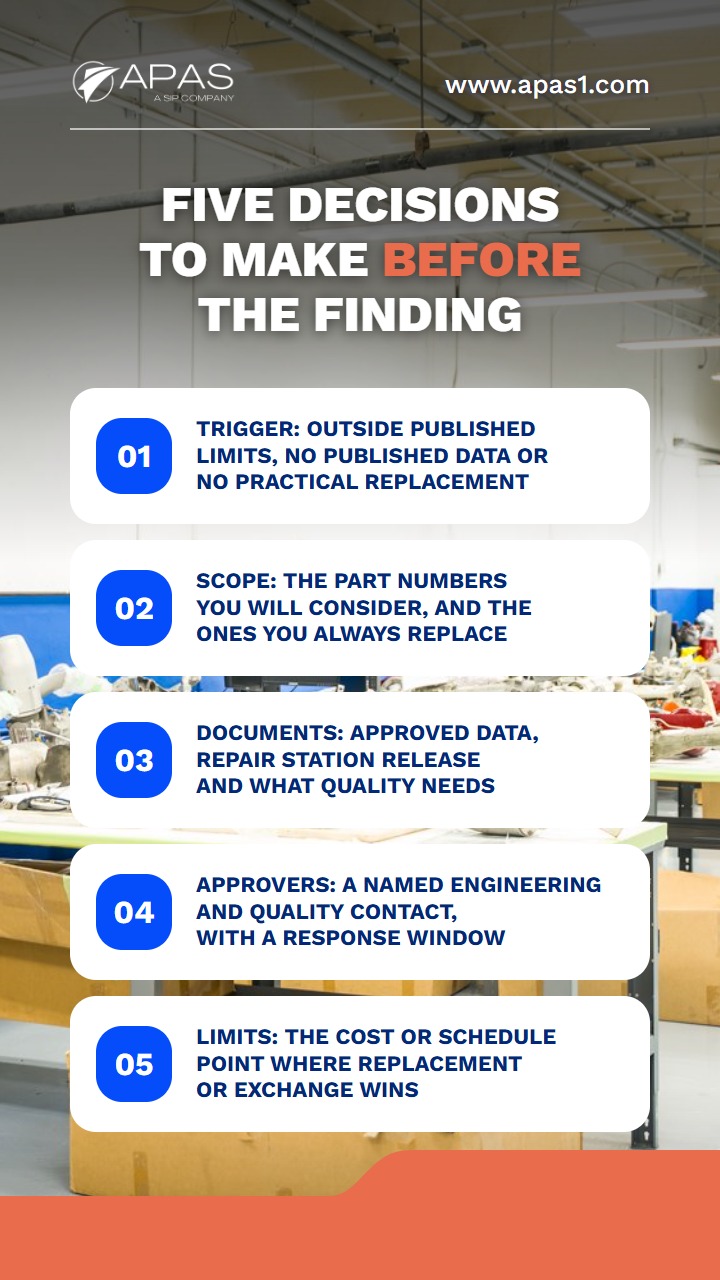
Run it against your own history. Take the last few out-of-limits findings on your fleet and walk each one through the five decisions as if the pathway had been in force: would it have put a DER repair on the table, who would have approved it, and which documents would have been needed?
The exercise tends to expose three kinds of gap:
Repeat the exercise when a lease changes, when a new fleet type arrives, or when a regulatory reference changes. A worked example of how a DER route runs on one specific assembly is in our article on DER repairs for landing gear components.
Cite current ones. The FAA's DER handbook changed revision in September 2026: FAA Order 8110.37G, issued on September 17, 2026, cancels 8110.37F. If your procedures or checklists cite the earlier revision, update them when you write the pathway.
The cost of a finding is set partly by the damage and partly by how long the organization takes to decide. A written DER pathway, with a trigger, a scope, a document list, named approvers and a limit, moves most of that decision to a calm week.
APAS evaluates DER repair pathways where the component, the data and the regulatory context support them, alongside exchange and replacement support. If you are drafting your own pathway and want a technical second look, our team can review it against the component families you fly. You can start from our DER repairs page.
It is a standing, written decision rule that an operator sets before any finding appears: the conditions under which it will consider a repair approved by a Designated Engineering Representative (DER) instead of a replacement, the documents it will accept as proof, and the people who can say yes.
When damage is outside published repair limits, when there is no published data for the damage, or when there is no practical replacement. Writing those trigger conditions down in advance avoids arguing the premise on every case.
Not after a major repair. Under 14 CFR 145.201, a certificated repair station may not approve a unit for return to service after a major repair unless the work followed applicable approved technical data. A DER, appointed under 14 CFR 183.29, is one of the people who can approve technical data for the FAA within their delegated limits.
FAA Order 8110.37G, issued on September 17, 2026, which cancels 8110.37F. Procedures or checklists that still cite the earlier revision should be updated.
Run it against your own history: take the last few out-of-limits findings on your fleet and walk each one through the five decisions (trigger, scope, documents, approvers and limits) as if the pathway had been in force. Repeat the exercise when a lease changes, a new fleet type arrives or a regulatory reference changes.